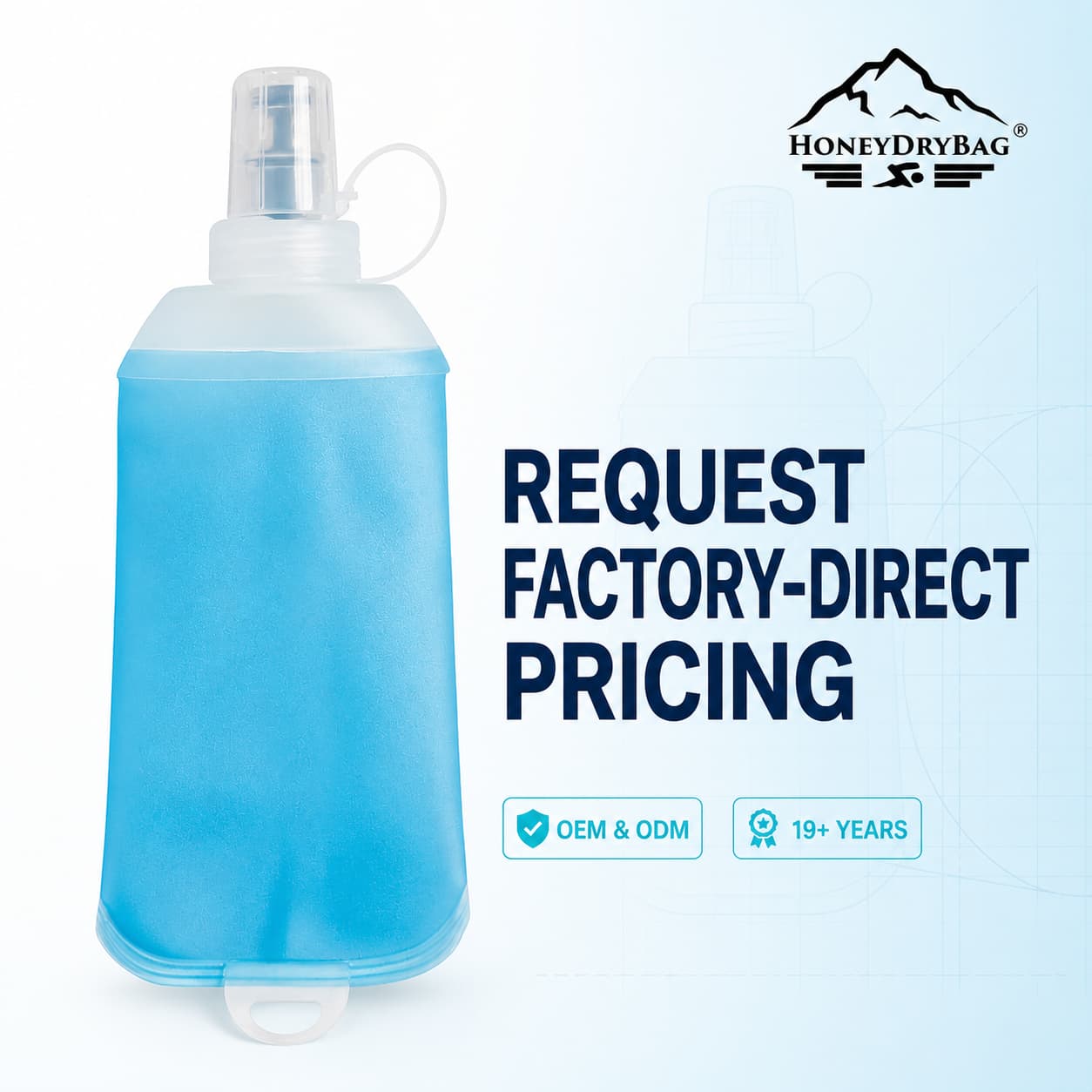
Quick answer: A soft flask is usually lighter, more flexible, and more packable than a hard bottle in a running hydration belt. It can collapse as the runner drinks, which reduces empty-bottle bulk. A hard bottle keeps its shape, is often easier to reinsert, and can be simpler to clean, but it may feel bulkier and can bounce if the belt is not designed around it. For brands, the right choice depends on belt pocket support, bottle shape, capacity, leakage control, and how the runner carries phone, gels, and keys.
Running belts have become more than phone storage. Many runners now use a waist belt as a compact hydration and nutrition system for road running, trail running, marathon training, and triathlon run sessions. That makes the bottle choice important. A belt designed for a hard bottle may not support a soft flask correctly, and a belt designed for soft flasks may not hold a rigid bottle comfortably.
Why the Bottle Type Matters in a Running Belt
A running belt moves around the waist and hips. Unlike a running vest, it has less vertical structure to stabilize the bottle. The belt pocket, elastic tension, body position, and bottle shape all affect whether the system feels stable.
A soft flask changes shape during use. When full, the liquid gives the bottle structure. When partly empty, the body collapses, folds, and becomes easier to squeeze. This is comfortable and space-saving, but it also means the belt pocket must support the flask at different fill levels.
A hard bottle keeps the same shape whether it is full, half full, or empty. That makes pocket design more predictable. However, the rigid shape can press into the lower back, hip, or abdomen, especially when the runner bends, climbs, or runs downhill.
For B2B buyers, the question should not be "which bottle is best?" The better question is: which bottle is best for the target belt, target runner, target distance, and target drink?
Soft Flask Advantages in a Running Hydration Belt
It becomes smaller as the runner drinks
The biggest advantage of a soft flask is that it collapses as liquid is consumed. In a running belt, this can reduce empty-bottle bulk and make the system feel less rigid late in the run.
A hard bottle remains the same size even when empty. That can be useful for reinsertion, but it does not reduce volume after drinking.
It feels softer against the body
A soft flask can conform to the curve of the waist or lower back. This is helpful in a belt because the bottle sits close to moving body parts. A rigid bottle may create pressure points if the belt pocket is positioned poorly.
It is easier to pack and ship
For brands, soft flasks are compact and lightweight. They can support product families that include running belts, hydration accessories, marathon kits, and triathlon race-day packs.
It can work well with squeeze drinking
A soft flask lets the runner squeeze liquid out through a bite valve. This can be convenient when the bottle is handheld or removed briefly from the belt.
The limitation is that squeezing also tests the cap and valve. If the belt compresses the bottle accidentally, leakage risk must be evaluated.
Soft Flask Limitations in a Running Belt
A soft flask is not automatically better. Its flexibility creates several design challenges.
It needs pocket support
If the belt pocket is too loose, the flask can bounce. If the pocket is too shallow, the cap and shoulder may move with each stride. If the pocket is too tight, the flask can be difficult to remove or reinsert.
It changes shape when half empty
Many samples look good when the flask is full. The harder test is the middle of the run, when the flask is half full. At that point, the base may curl, the body may fold, and the flask may lose contact with the belt pocket.
It can be squeezed by other gear
Phones, gels, keys, and food pouches can press into the soft flask. This may create bounce, reduce usable volume, or push liquid toward the valve.
It may require more cleaning attention
Soft flasks are often used for electrolyte drink, carbohydrate mix, or gel-style fuel. Residue can collect around the cap, bite valve, and shoulder. If the bottle is folded or closed before drying, odor and taste problems may increase.
For sports drink handling, see How to Fill a Soft Flask With Powdered Drink Mix Without Making a Mess. For repeated taste issues, see Why Does My Running Soft Flask Taste Like Plastic?.
Hard Bottle Advantages in a Running Belt
It keeps its shape
A hard bottle is easier to design around because the shape does not collapse. The pocket can be built to match a fixed bottle diameter, and reinsertion is usually more predictable.
It may be easier to clean
Many hard bottles have wider openings and more rigid walls, making brushing and drying easier. This can matter if the product is mainly used with sports drink.
It may be faster to refill
A hard bottle can stand more easily on a table and may be easier to fill at home or at an aid station. The rigid body is less likely to fold when the runner pours water or powder.
It is less affected by phone pressure
A phone or gel packet pressing against a hard bottle is less likely to deform it. The trade-off is that the pressure may transfer to the runner's body instead.
Hard Bottle Limitations in a Running Belt
A hard bottle is not always more stable. If the belt is not designed for it, the bottle can bounce, rotate, or push the belt downward.
Hard bottles can also feel bulky. A bottle that works well on a bike cage may not feel good against the lower back during running. The fixed shape may interfere with arm swing, bending, or sitting before and after the run.
For lightweight road running and race-day use, many runners prefer a soft flask because it becomes less noticeable as it empties. For walking, hiking, or slower long runs, some runners may accept the bulk of a hard bottle in exchange for easier handling.
Soft Flask vs Hard Bottle: Practical Comparison
| Factor | Soft flask | Hard bottle | B2B testing note |
|---|---|---|---|
| Body feel | Softer and more body-conforming | More rigid | Test against waist, hip, and lower back pressure |
| Empty volume | Collapses as liquid is consumed | Stays the same size | Test late-run comfort and storage |
| Reinsertion | Can fold when half empty | Usually easier to slide back | Test one-handed reinsertion while moving |
| Bounce control | Needs strong pocket support | Needs secure bottle cradle | Test full, half-full, and empty conditions |
| Sports drink use | Good if valve and cleaning are suitable | Often easier to rinse | Test residue, odor, and valve flow |
| Shipping and kit design | Compact and lightweight | Bulkier | Compare packaging and replacement-part strategy |
| Pocket compatibility | Shape-sensitive | Diameter-sensitive | Test with real belt pocket dimensions |
Which Capacity Works Better?
Capacity affects comfort more in a belt than many buyers expect. A 500 ml bottle adds noticeable weight at the waist. Two 500 ml bottles can carry useful volume, but they also require better belt structure and load balance.
Smaller soft flasks, such as 150-250 ml, can work well for race-day rinse water, concentrated fuel, or short training runs. A 300-350 ml flask may offer a middle ground. A 500 ml flask is better for longer runs, but it needs deeper pocket support and careful bounce testing.
For hard bottles, the shape is often the limiting factor. A short, curved bottle may fit a belt better than a tall straight bottle. For soft flasks, maximum filled width and shoulder shape may matter more than nominal volume.
What About Sports Drink, Gel, or Powdered Mix?
The liquid inside the bottle affects the choice. Plain water is the simplest case. Electrolyte drink, carbohydrate drink, and gel-style fuel create more risk of residue, sticky leakage, and valve-flow problems.
A soft flask can work well with sports drink if the valve flows properly and the bottle is cleaned after use. But thick drink mix may require more careful testing than water. A hard bottle may be easier to clean, but if it leaks inside the belt, sticky liquid can reach clothing, phone pockets, or food.
Brands should test:
- Plain water
- Electrolyte drink
- Powdered drink mix
- Diluted carbohydrate drink
- Any concentrated fuel use case claimed in marketing
If hot-weather use is part of the product story, also check Can You Freeze a Soft Flask for Hot Runs?.
What Should B2B Buyers Test Before Choosing?
1. Bottle and pocket dimensions
Record filled length, maximum width, cap diameter, cap height, base shape, and valve position. For the belt, record pocket depth, opening width, elastic tension, and whether the bottle sits at the back, side, or front.
2. Full and half-full movement
Test the bottle full, three-quarters full, half full, nearly empty, and empty. Soft flasks change shape; hard bottles do not. Both can still bounce if the belt does not control the load.
3. Removal and reinsertion
A bottle is not belt-compatible if the runner can remove it but cannot put it back without stopping. Test one-handed use, wet hands, and movement at easy running pace.
4. Compression and leakage
Place the bottle in the belt with a phone, gels, and keys. Then test bending, jogging, faster running, and squeezing against the body. Check cap threads, bite valve, welds, and pocket wetness.
5. Cleaning and drying
If the system is sold for sports drink, test cleaning after repeated use. For soft flasks, pay attention to the cap, shoulder, bite valve, and drying time. For hard bottles, check whether the belt pocket traps moisture or odor.
6. Replacement parts
For B2B programs, clarify whether replacement caps, bite valves, or bottles can be ordered separately. A belt system becomes harder to support if the bottle is unique but replacements are unavailable.
For a broader sourcing overview, read our complete B2B guide to foldable TPU running water bottles.
Final Takeaway
A soft flask is often the better choice for a running hydration belt when the goal is lightweight comfort, body-conforming fit, and reduced empty-bottle bulk. A hard bottle can be better when the buyer prioritizes shape stability, predictable reinsertion, and simpler cleaning.
Neither option is universally best. The correct choice depends on the belt pocket, bottle capacity, drink type, phone and gel storage, and how the runner uses the system during a real run.
For brands and B2B buyers, the safest approach is to test the bottle and belt together. Compare soft flask and hard bottle samples at full, half-full, and empty conditions before approving production or making compatibility claims.
Honey Dry Bag works with running, triathlon, and outdoor brands on OEM and ODM soft flask projects. Contact us to discuss capacity options, cap and valve choices, belt compatibility testing, branding, packaging, and sample development for your hydration product line.