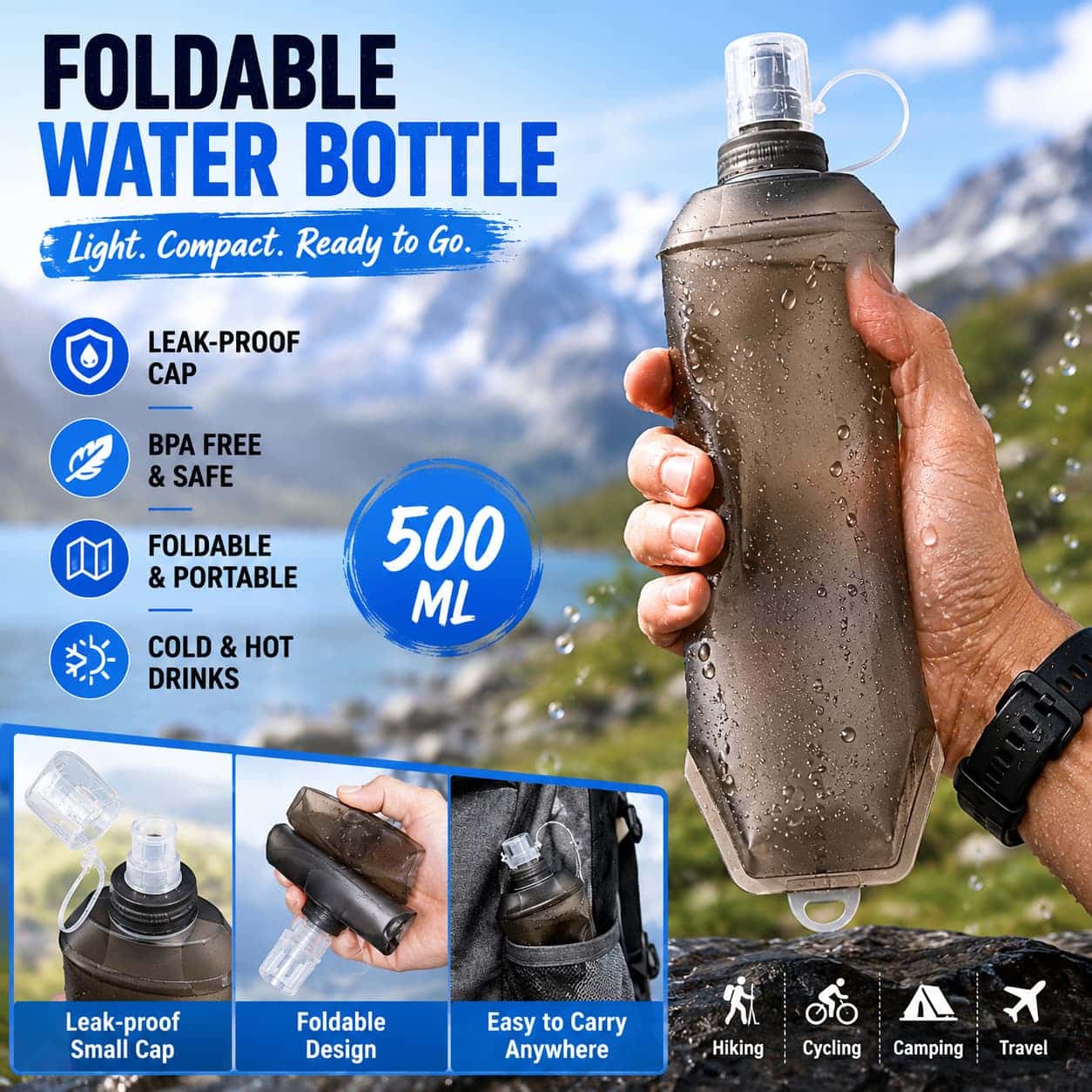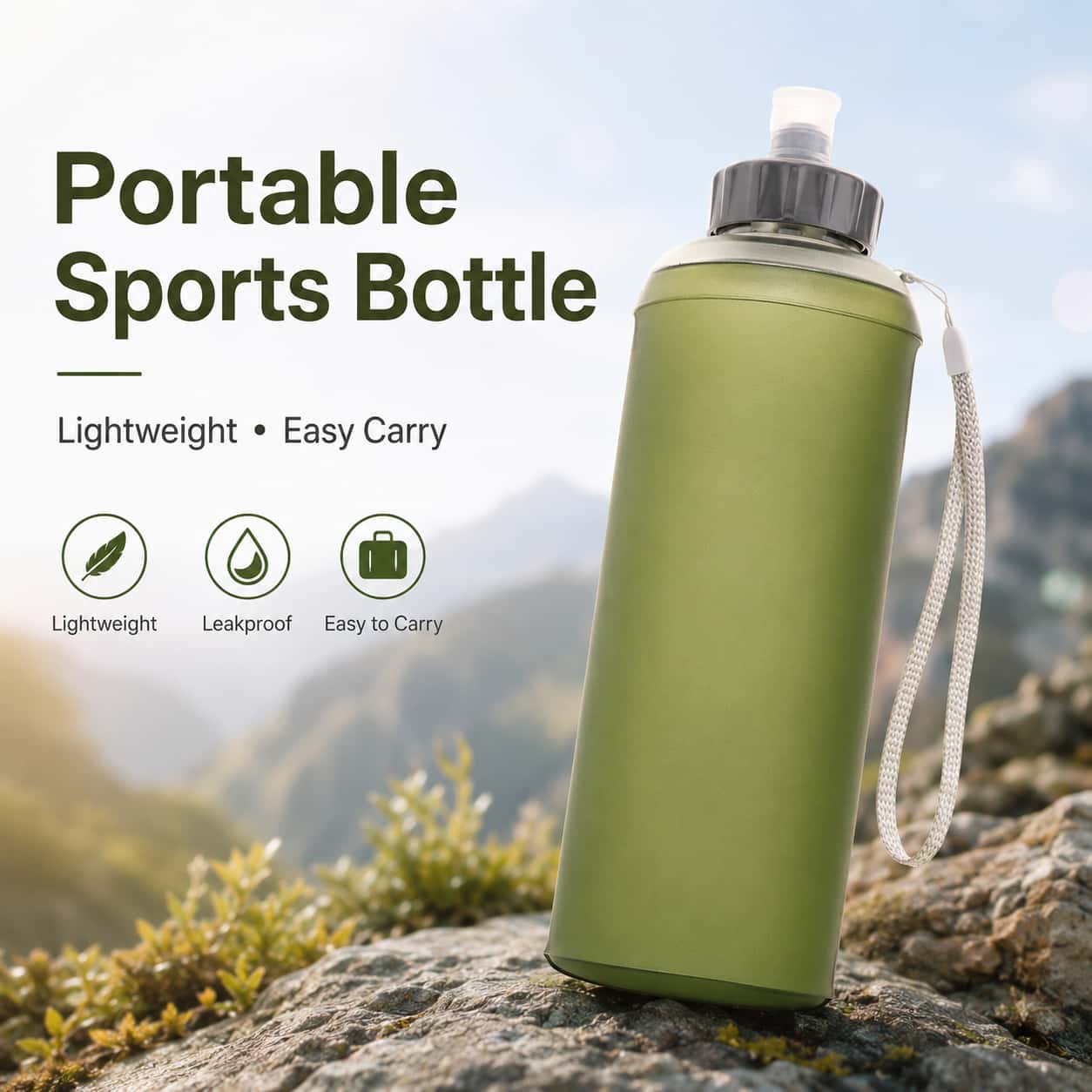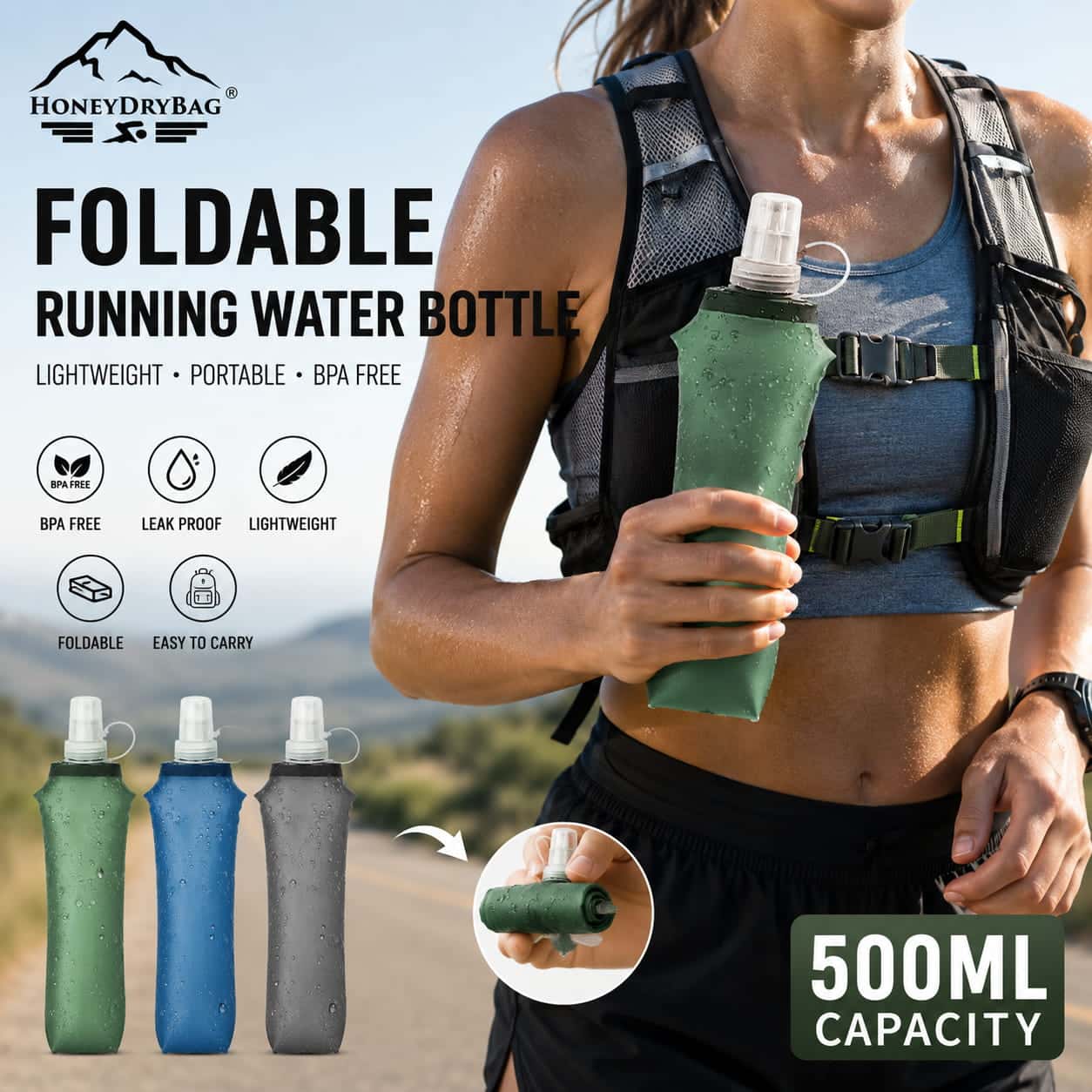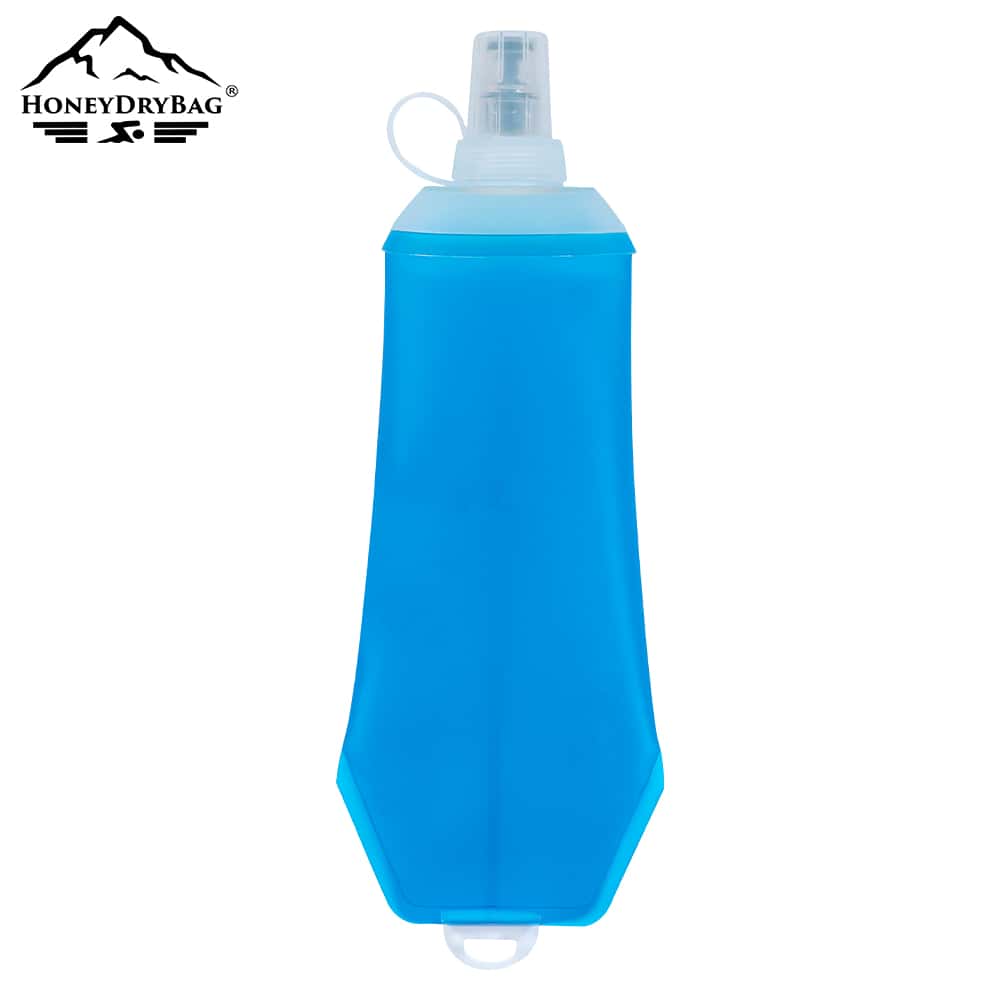
Quick answer: Some collapsible water bottles can stand upright when full, but self-standing performance is not automatic. A flat or gusseted base may support a filled bottle on a level surface, while a thin running soft flask may lean, fold, or fall as the water level drops.
Whether a collapsible water bottle can stand up depends on its base footprint, body stiffness, fill level, cap weight, storage creases, and the surface beneath it. A bottle that stands when completely full may not remain stable when half full or nearly empty.
That behavior is not necessarily a defect. Running soft flasks often prioritize low weight, flexibility, vest fit, and compact storage over tabletop stability.
What Does Self-Standing Mean for a Collapsible Bottle?
A self-standing collapsible water bottle should remain upright without external support under defined test conditions. The definition is incomplete unless it identifies:
- Fill level
- Installed cap, valve, straw, or attachment
- Surface type and slope
- Whether the base is wet or dry
- Required standing time
- Bottle condition before the test
For example, a bottle may stand when it is full, capped, and placed on a dry level table with its base fully expanded. The same product may become unstable after water is consumed, excess air is removed, or the bottom develops a storage crease.
B2B buyers should therefore treat “self-standing” as a measurable product requirement rather than an impression taken from a catalog photograph.
Why Can Some Collapsible Water Bottles Not Stand Up?
The Body Is Designed to Collapse
A flexible water bottle loses volume as the user drinks. In a running application, that can reduce empty storage space and help the flask conform to a vest pocket.
The trade-off is reduced structural support. A thin TPU collapsible water bottle may work well against the runner's body but behave poorly as a freestanding tabletop bottle.
The Base Has a Small or Uneven Footprint
A rounded or narrow base can make pocket insertion easier, but it provides less contact area on a table.
A flat base, shaped weld, or gusset can create a broader footprint. That feature improves stability only when the base opens consistently and the filled body remains reasonably symmetrical.
The Cap Makes the Bottle Top-Heavy
The flexible body may weigh little compared with a large cap, locking mechanism, extension straw, or filter attachment. As the water level falls, the upper components represent a larger share of the remaining weight.
A narrow base combined with a relatively heavy cap can make the bottle easier to tip. Stability testing should use the exact cap and accessories intended for production.
Stability Changes With Fill Level
Liquid gives a flexible bottle shape and adds weight low in the body. As liquid is consumed, the upper body may fold and the distribution of weight changes.
A bottle that stands reliably at nominal capacity may lean at half capacity and collapse when nearly empty. Product photographs showing only a fully filled sample do not demonstrate stability during normal use.
Removing Air Makes the Body Softer
Runners often squeeze excess air out of a soft flask before closing it. That can reduce liquid movement, but it also leaves less internal support.
A de-aired running soft flask should not be expected to behave like a rigid bottle unless its base and body include additional structure.
Folding and Storage Affect the Base
Collapsible bottles may be stored flat, folded, rolled, or compressed in retail packaging. If the bottom does not reopen evenly after filling, one side may sit higher than the other.
The deformation may relax after use, or it may continue to affect the standing footprint. The result depends on the complete construction and storage condition.
The Surface Is Part of the Test
A bottle that stands on a dry laboratory table may not stand on gravel, grass, a wet aid-station table, a sloped trail, or soft ground.
Marketing should describe the conditions actually demonstrated. “Stands on a level surface when full” is narrower and more useful than an unsupported universal claim.
Does a Running Soft Flask Need to Stand Upright?
Usually, standing stability is not the first design priority for a running soft flask. It is normally carried in:
- A hydration-vest pocket
- A running belt
- A handheld sleeve
- A pack pocket
- The runner's hand
In these applications, comfort, low empty weight, reduced liquid movement, reliable sealing, compact storage, and compatibility with the carrying system may matter more than the ability to stand on a table.
Adding a wider or more rigid base can improve tabletop use, but it may also increase weight, create a firmer contact point, or make the flask harder to insert into a narrow pocket. The correct balance depends on the target application.
When Is a Self-Standing Collapsible Water Bottle Useful?
Self-standing performance has more value when users regularly place the bottle down during filling or drinking, including:
- Travel
- Gym use
- Desks and workplaces
- Campsites
- Race aid stations
- Handheld training
- Everyday hydration
- Some water-filter setups
A general-purpose travel bottle may justify more structure than a dedicated racing flask. A product intended for both applications needs an explicit compromise between packability, weight, stability, and carrying-system fit.
How Different Collapsible Bottle Structures Behave
These are general design tendencies rather than guarantees based on material names.
| Bottle structure | Typical standing behavior | Main advantage | Main limitation |
|---|---|---|---|
| Thin TPU running soft flask | May stand when full; often loses stability as it empties | Lightweight and vest-friendly | Limited tabletop support |
| Gusseted flexible pouch | Can stand when the base expands evenly | Packs relatively flat | Stability changes with fill level and base shape |
| Accordion-style flexible bottle | Retains more vertical structure in its expanded form | More bottle-like handling | Usually bulkier when collapsed |
| Flexible bottle with a supported base | More stable on a level surface | Better tabletop usability | Adds weight and fixed structure |
| Rigid bottle | Usually stable across more fill levels | Easy to place and refill | Does not collapse for compact storage |
Actual performance depends on the base, body construction, cap, dimensions, fill condition, and surface—not on whether the product is simply labelled TPU, silicone, flexible, or collapsible.
Is a Wider or Rigid Base Always Better?
No. A larger standing footprint can improve stability, but it may create new problems:
- The bottle may no longer fit the intended vest pocket.
- The bottom may catch during insertion.
- Extra weld geometry may complicate production control.
- A supported base may feel bulky against the body.
- The empty bottle may not pack as flat.
- Corners may make draining or cleaning less convenient.
For a custom collapsible water bottle, base design should be assessed together with the target vest, belt, pack, cup holder, or tabletop use.
Does Wall Thickness Improve Collapsible Water Bottle Stability?
Greater body stiffness may help a flexible bottle retain its shape, but wall thickness alone does not determine whether it will stand.
Other variables include:
- Material formulation
- Film or molded-body construction
- Bottle width and height
- Base profile
- Seam geometry
- Neck position
- Cap weight
- Fill level
- Storage creases
Increasing thickness may also add weight and reduce flexibility. Buyers should not request a thicker wall as the only solution without testing the complete design.
How Should Runners Fill a Bottle That Will Not Stand?
If a soft flask does not stand on its own:
- Hold it by the neck while filling.
- Support the body without squeezing liquid back out.
- Use a cup, pouch, or vest pocket as temporary support when appropriate.
- Do not leave an open flask balanced on an uneven surface.
- Close the cap before setting the flask down.
- Keep the bite valve away from dirty surfaces.
- Check the seal before returning it to the carrying system.
At an aid station, controlling the neck is usually more reliable than trying to balance an empty flexible body.
How Should B2B Buyers Test Bottle Stability?
Buyers who are still defining material, capacity, cap, and basic flask construction can first review our B2B guide to foldable TPU running water bottles before creating a stability requirement.
Define the Claim
State what the product must do:
- Stand only when full or at additional fill levels
- Use a specified cap and accessory configuration
- Stand on a defined dry or wet surface
- Remain upright for a stated duration
- Perform before and after defined storage or folding
Without those conditions, suppliers may interpret “self-standing” differently.
Test Relevant Fill Levels
Evaluate the bottle when full, partly filled, and nearly empty if those conditions occur during normal use. Record whether it remains upright, leans, folds, or falls.
Do not use a fully filled photograph as the only evidence.
Use the Production Cap System
Test with the exact bite valve, locking cap, straw, or attachment intended for sale. Changing the top components can change both weight distribution and the way the body is loaded.
Include Storage Conditioning
Where relevant, evaluate samples after they have been stored flat, rolled, folded, packaged, or compressed for a defined time. Record whether the base reopens consistently.
Match the Surface to the Claim
A desk bottle may need a dry level tabletop test. A race product may also need a wet aid-station surface. An outdoor product may require firm but slightly uneven ground.
Not every bottle needs to pass every surface. The method should match the advertised use.
Compare Production With the Approved Sample
Check multiple production samples for base expansion, body symmetry, neck alignment, seam position, cap seating, and filled shape. A stable development sample does not establish that every production unit behaves identically.
B2B Stability Test Record
| Test item | Condition to define | Result to record |
|---|---|---|
| Fill level | Full, partial, or nearly empty | Upright, leaning, folded, or fallen |
| Cap configuration | Valve, cap, straw, or attachment | Exact components used |
| Surface | Level, wet, dry, or defined uneven surface | Test environment |
| Storage condition | Flat, rolled, folded, or packaged | Method and duration |
| Bottle orientation | Natural filled position | Visible deformation |
| Standing duration | Buyer-defined | Time before movement |
| Sample source | Development or production | Sample or batch identity |
| Replication | Buyer-defined | Units and repetitions tested |
Acceptance criteria should be established for the specific project rather than copied from an unrelated bottle.
Questions to Ask a Collapsible Water Bottle Manufacturer
- Is the proposed bottle intended to stand when full?
- What happens as the liquid level drops?
- How is the base formed and controlled?
- Does the selected cap make the bottle top-heavy?
- Can the bottle be evaluated after folded or packaged storage?
- Will the base fit the target vest, belt, or holder?
- Can production samples be compared with the approved sample?
- Can a self-standing claim be demonstrated under written conditions?
- Does improving stability change weight, dimensions, comfort, or packability?
These questions identify points to confirm during development. They do not imply that every base option or stability test is available for every Honey Dry Bag model.
Final Takeaway
A collapsible water bottle can stand up on its own, but only some designs do so reliably, and usually under defined conditions. Base geometry, body stiffness, cap weight, fill level, storage history, and surface all influence the result.
Runners should choose according to how the bottle will be carried and filled rather than treating tabletop stability as a universal quality measure. B2B buyers should define “self-standing,” test the production configuration at relevant fill levels, and keep marketing claims within the demonstrated conditions.
Honey Dry Bag works with hydration and outdoor brands on OEM and ODM product development. Contact us with the intended use, bottle shape, target capacity, base requirement, cap system, carrying method, branding, packaging, and destination market so available options can be evaluated.