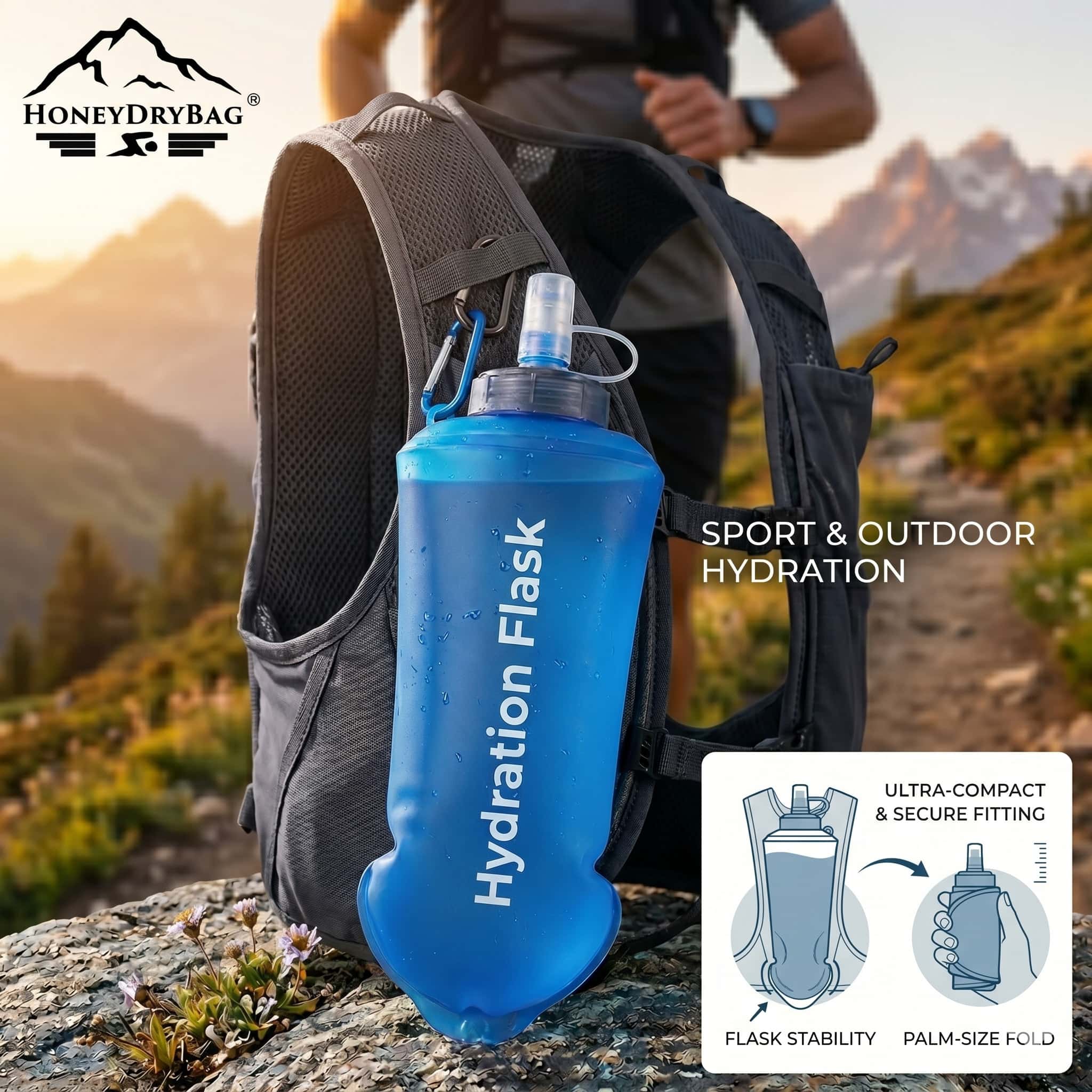
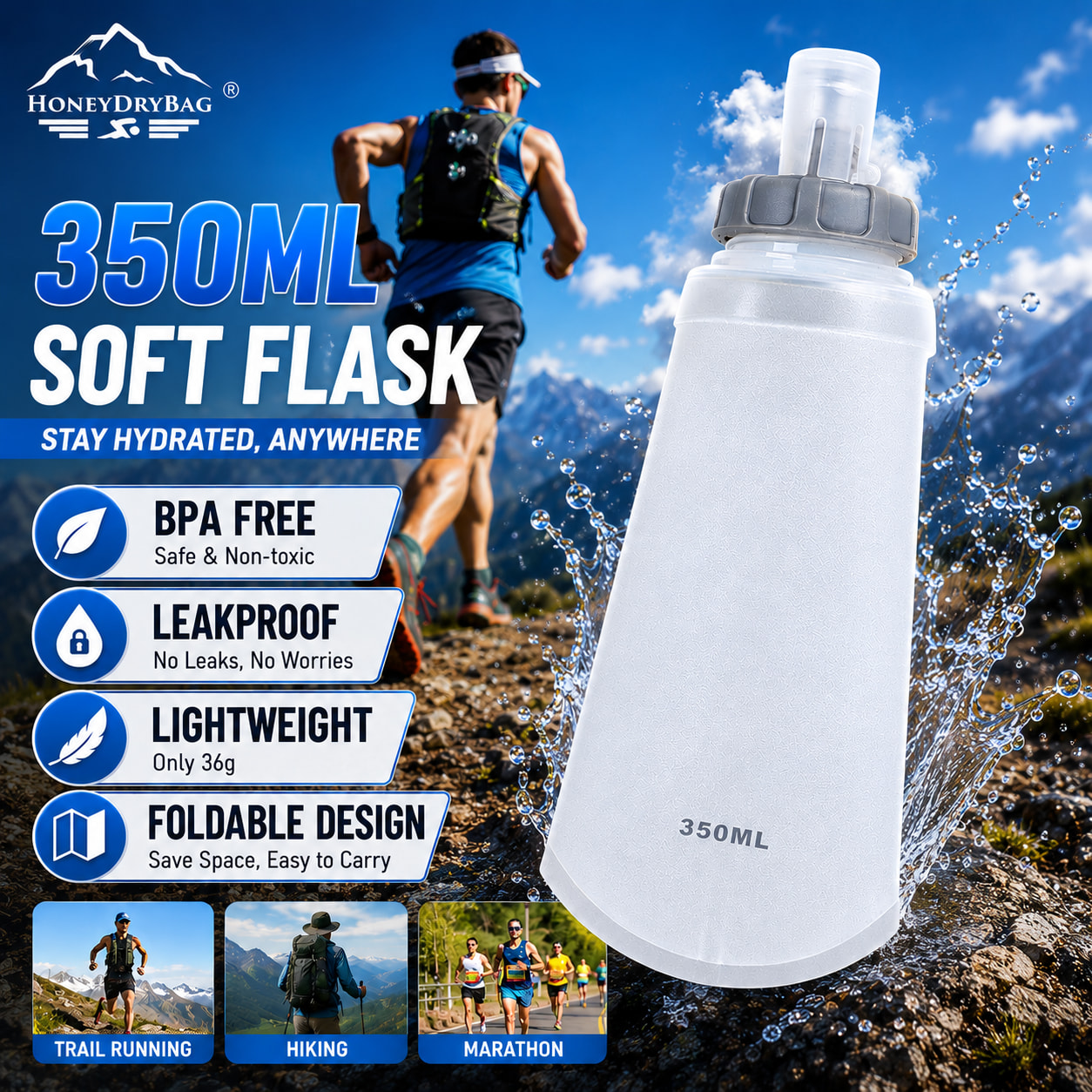
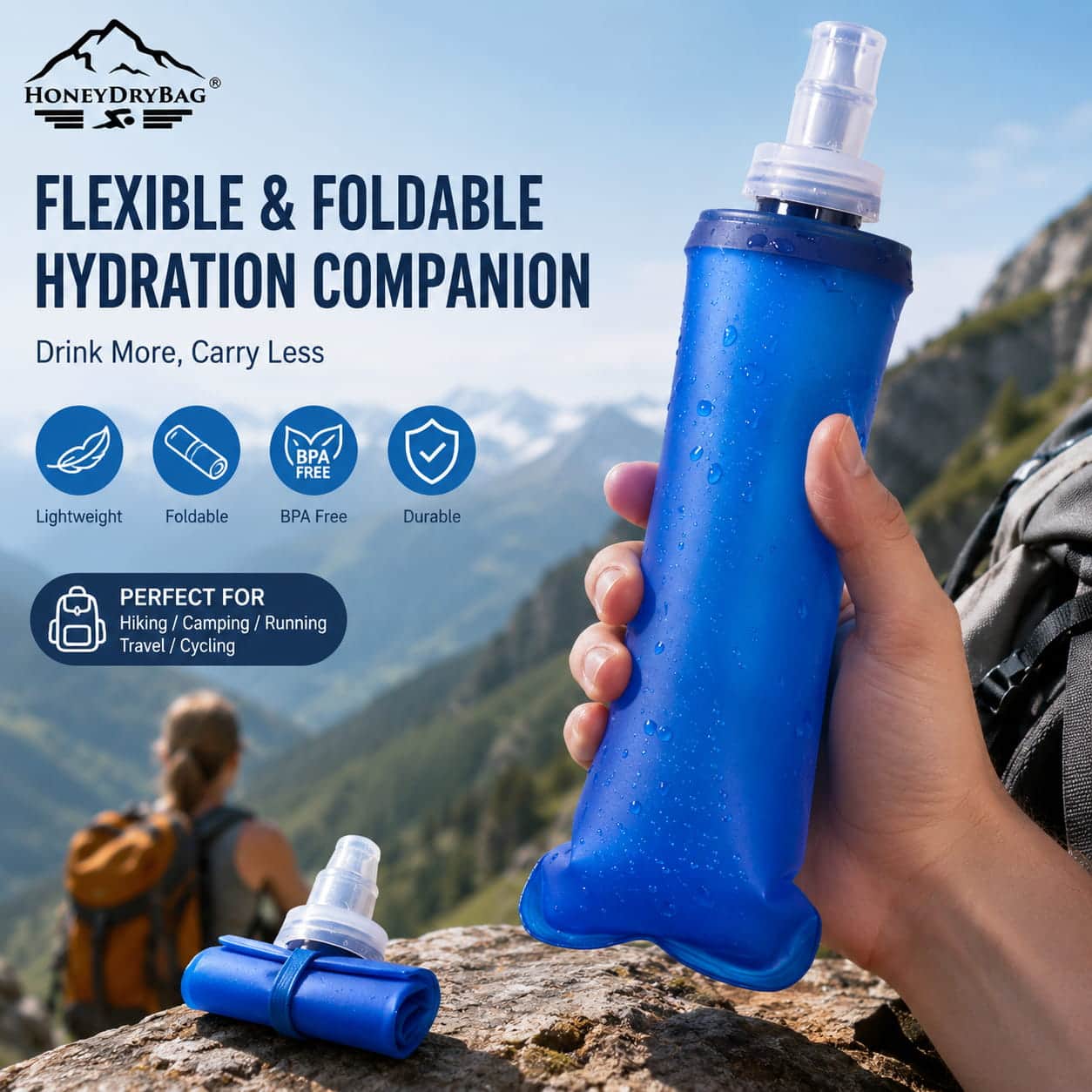
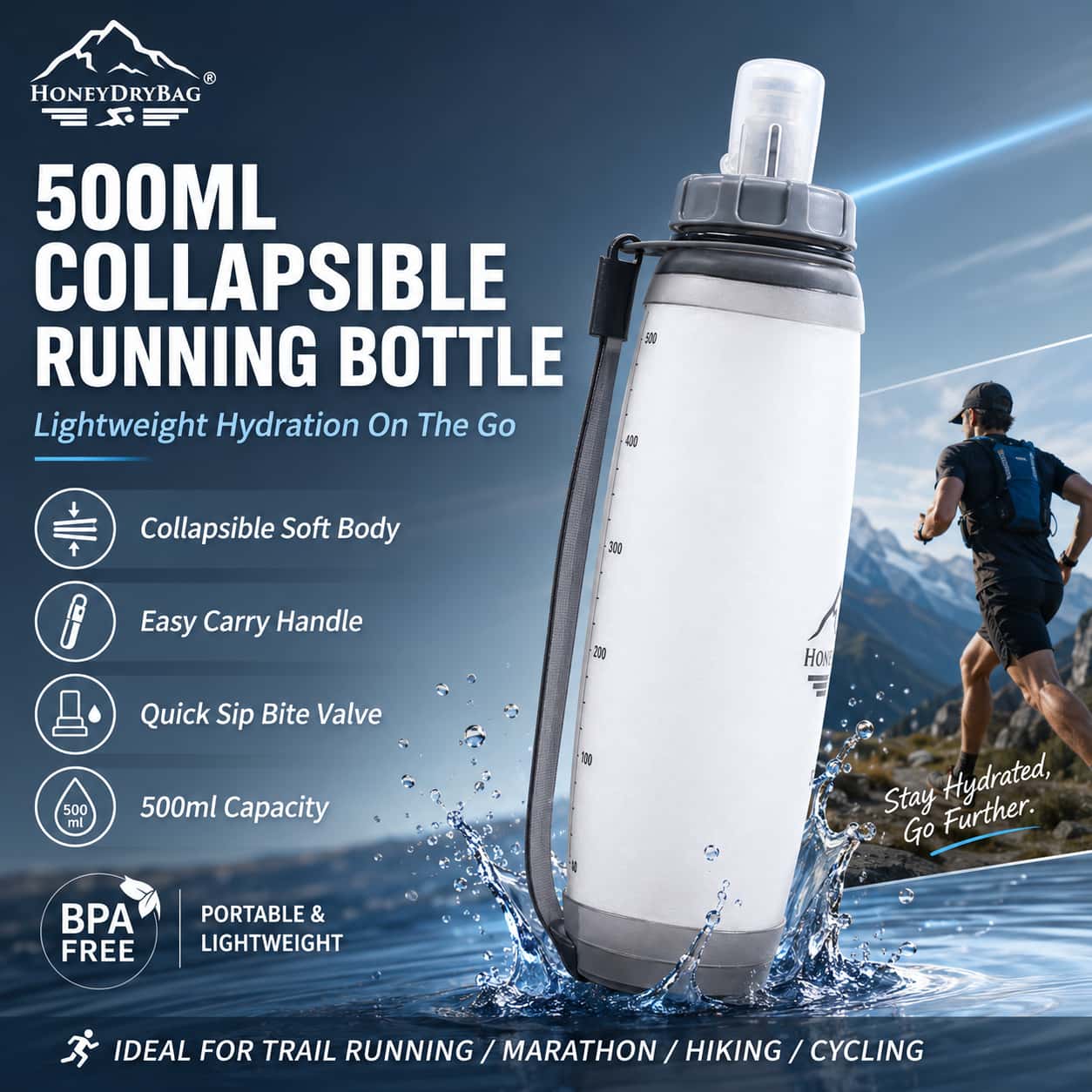
Quick answer: A soft flask does not always have to be carried inside a running vest. Depending on the application, a custom soft flask can also be developed with an additional hand strap or carrying component.
In one real customer sample project, Honey Dry Bag inspected two customized soft flask samples with attached hand straps.
The inspection included physical measurements, weight, printing adhesion, material and construction condition, and water leakage testing.
The test was performed on August 5, 2026 by Hangzhou Dawnjoint Business And Trading Co., Ltd. / Honey Dry Bag.
Customer-identifying information, order information and customer branding have been redacted from the public version.
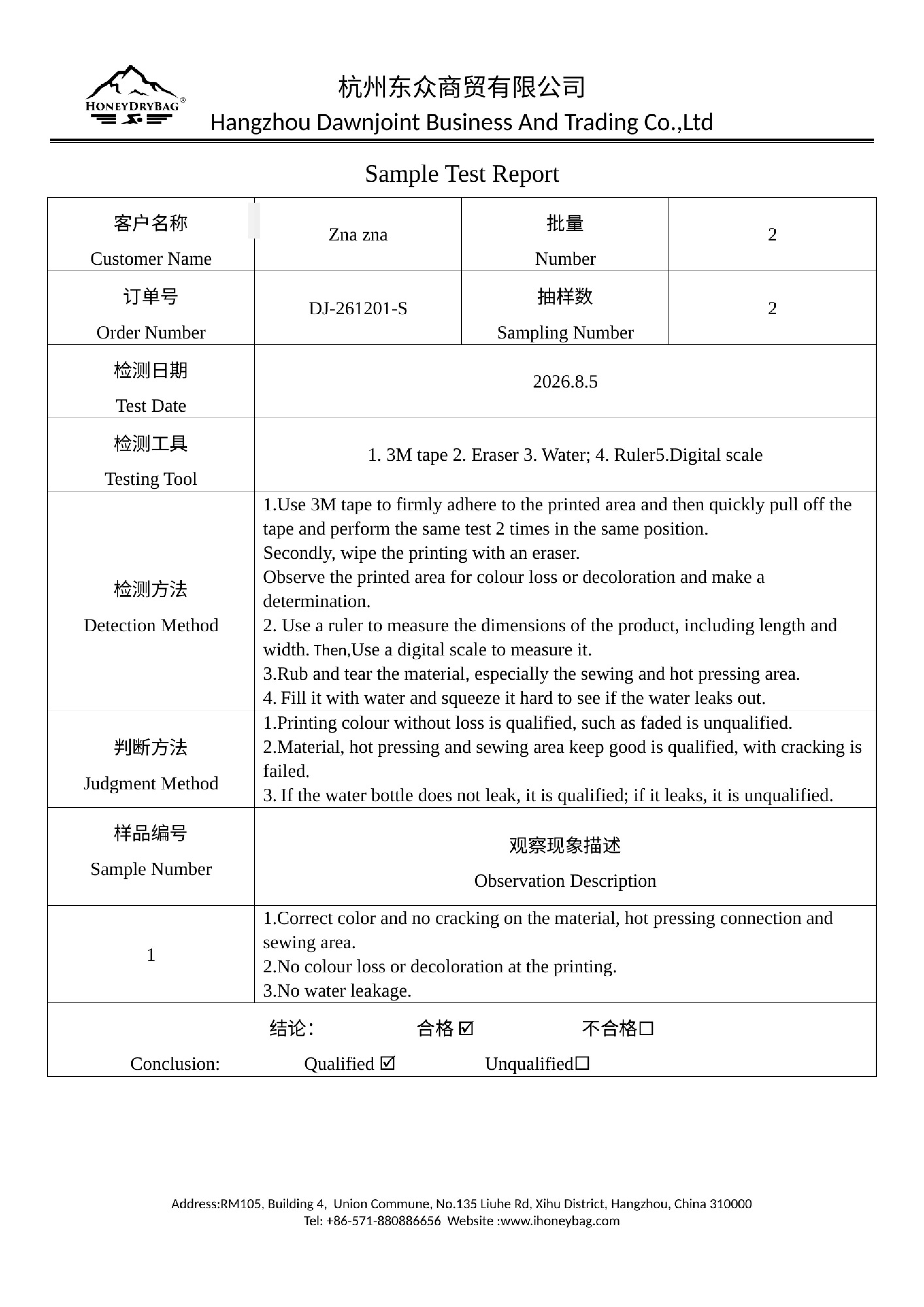
A Real Custom Soft Flask With Hand Strap Project
Most runners are familiar with soft flasks carried in the front pockets of a running vest.
But that is not the only possible configuration.
For this customer project, the soft flask was combined with a separate hand strap component.
This creates a different carrying configuration and also changes some of the characteristics that should be considered during product development.
The internal sample report recorded:
Test date: August 5, 2026
Quantity: 2
Sampling quantity: 2
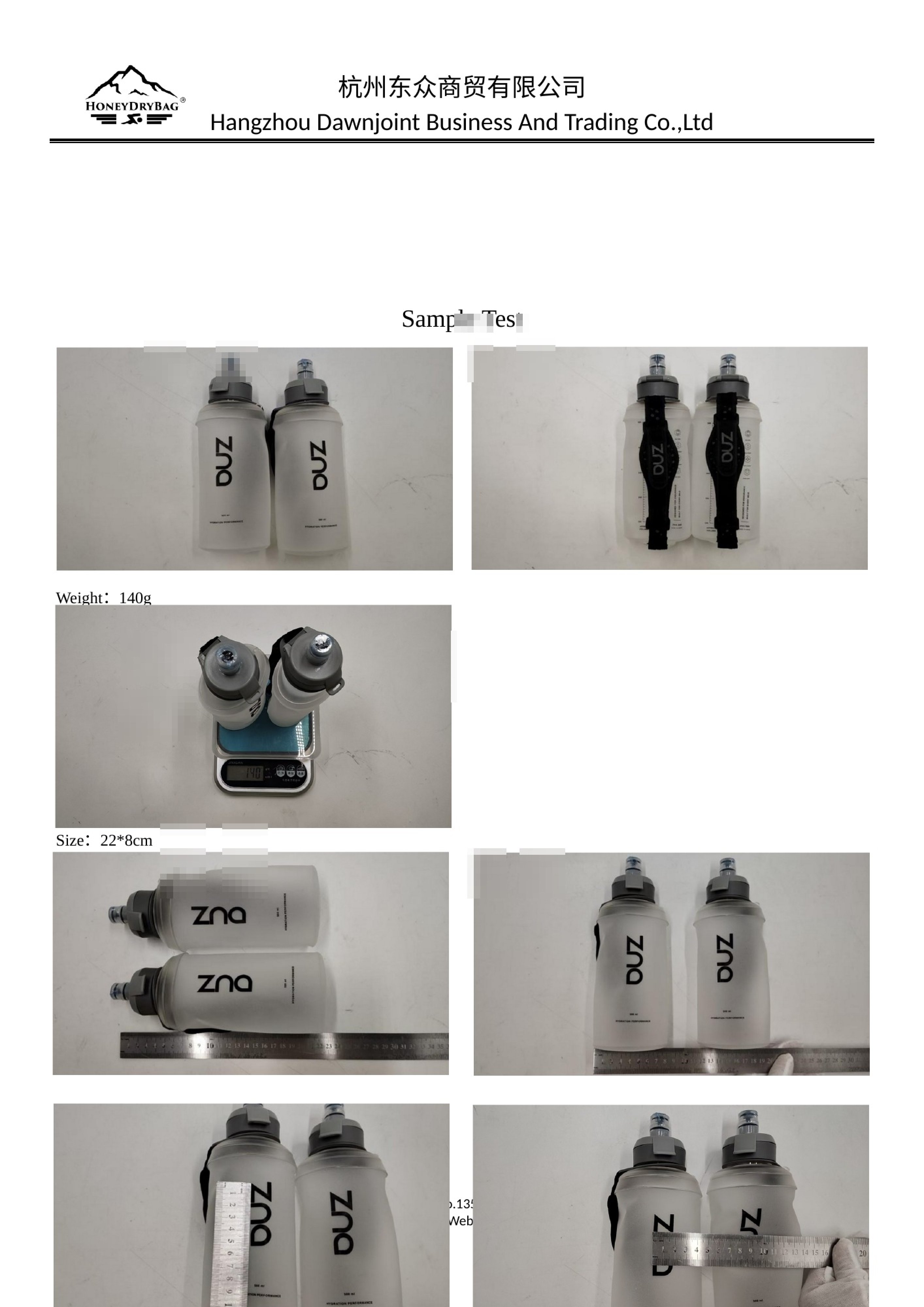
Measured weight: 140g
Measured dimensions: 22 × 8cm
Testing tools included:
- 3M tape
- Eraser
- Water
- Ruler
- Digital scale
The photographs below show the actual samples and measurements used during the inspection.
Why Add a Hand Strap to a Soft Flask?
A standard running soft flask is often designed to fit inside a hydration vest pocket.
A hand strap creates another possible carrying method.
Instead of relying entirely on a vest pocket, the runner can hold the flask using the attached carrying component.
This type of configuration may be considered for:
- Running
- Trail running
- Short training sessions
- Handheld hydration
- Outdoor activities
- Products designed without a hydration vest
For a B2B buyer, however, adding a strap is not simply a cosmetic change.
It can influence the complete product specification.
Actual Weight: 140g
The samples documented in this project were weighed using a digital scale.
The recorded weight was:
140g
This number should be understood in context.
It refers to the product configuration shown in this particular sample inspection, including its attached components.
It should not be interpreted as the standard weight of every soft flask.
A simpler soft flask without additional carrying components can have a substantially different finished weight.
For B2B sourcing, this is why it is useful to confirm exactly what is included when comparing product weight.
Questions may include:
- Does the quoted weight include the cap?
- Does it include the bite valve?
- Does it include a hand strap?
- Are additional components attached?
- Is the weight based on an actual production sample?
Actual sample measurement can provide a clearer answer than a generic specification.
Actual Dimensions: 22 × 8cm
The report also records the physical dimensions of the sample as:
22 × 8cm
The sample was measured using a ruler during the inspection.
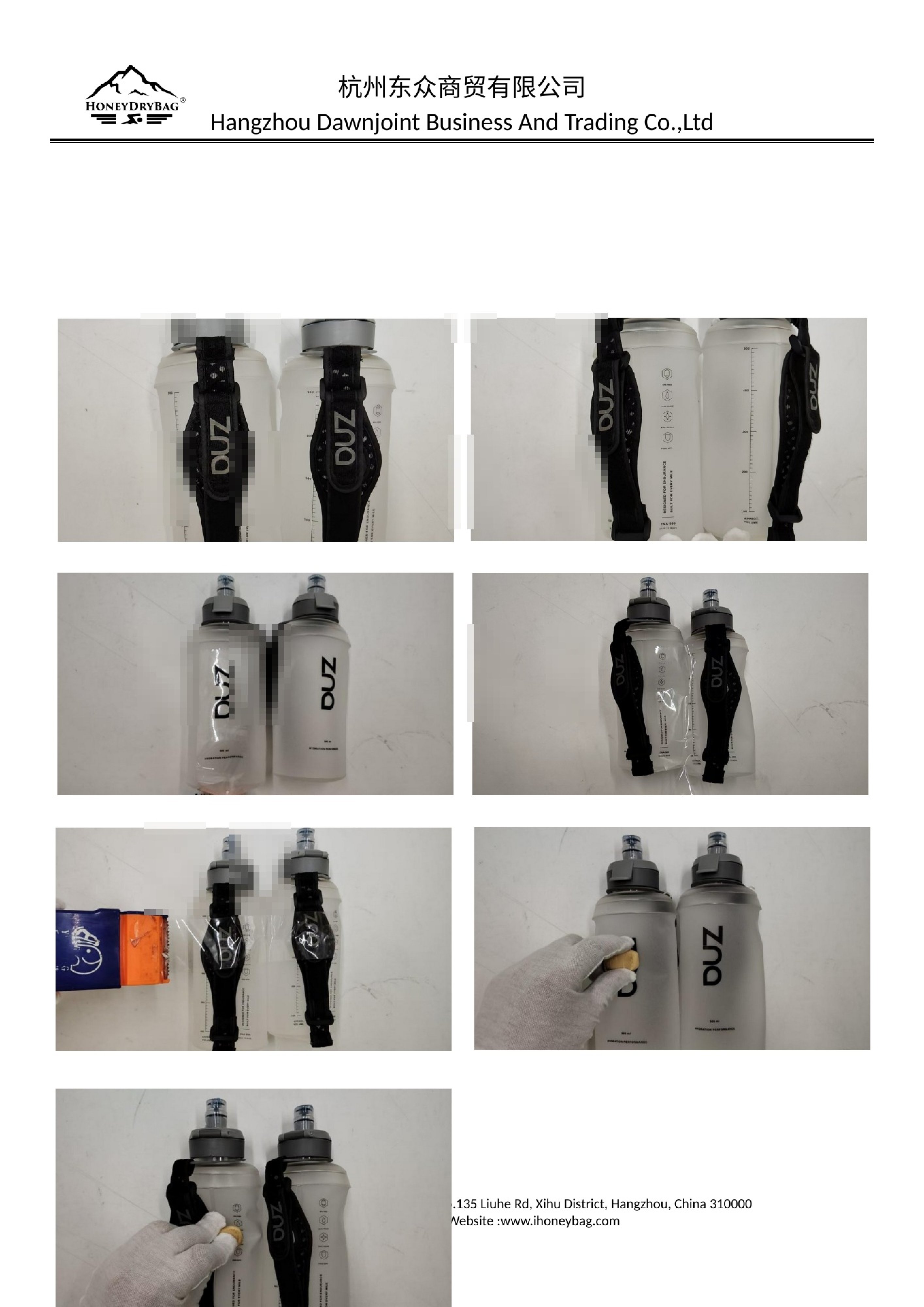
Physical dimensions matter because capacity alone does not describe the complete shape of a soft flask.
Two products can have similar capacities but different:
- Lengths
- Widths
- Body profiles
- Neck designs
- Carrying accessories
When a strap or other accessory is added, the buyer should also consider how the complete product will feel and function during use.
Testing the Custom Printing
This sample also included customized customer branding.
For OEM and private-label projects, printing should be considered part of the product specification rather than only a decorative feature.
The report describes a printing adhesion test using 3M tape.
The tape was firmly applied to the printed area and quickly removed.
The same test was performed twice in the same position.
The printing was also wiped with an eraser and inspected for colour loss or decoloration.
For the samples documented in this report, the recorded observation was:
No colour loss or decoloration at the printing.
Customer branding has been redacted from the photographs published on this website.
Checking Material and Construction
Flexible hydration products are repeatedly squeezed and deformed during normal use.
A handheld configuration can also introduce different handling compared with a flask that remains inside a vest pocket.
The inspection therefore included rubbing and pulling the material, particularly around relevant construction areas.
The report recorded:
Correct color and no cracking on the material, hot pressing connection and sewing area.
This is an observation from these inspected samples.
It is not intended as a universal claim about every soft flask or every future production batch.
Water Leakage and Compression Test
The functional inspection also included a water leakage test.
The samples were filled with water and squeezed firmly to check whether water leaked from the product.
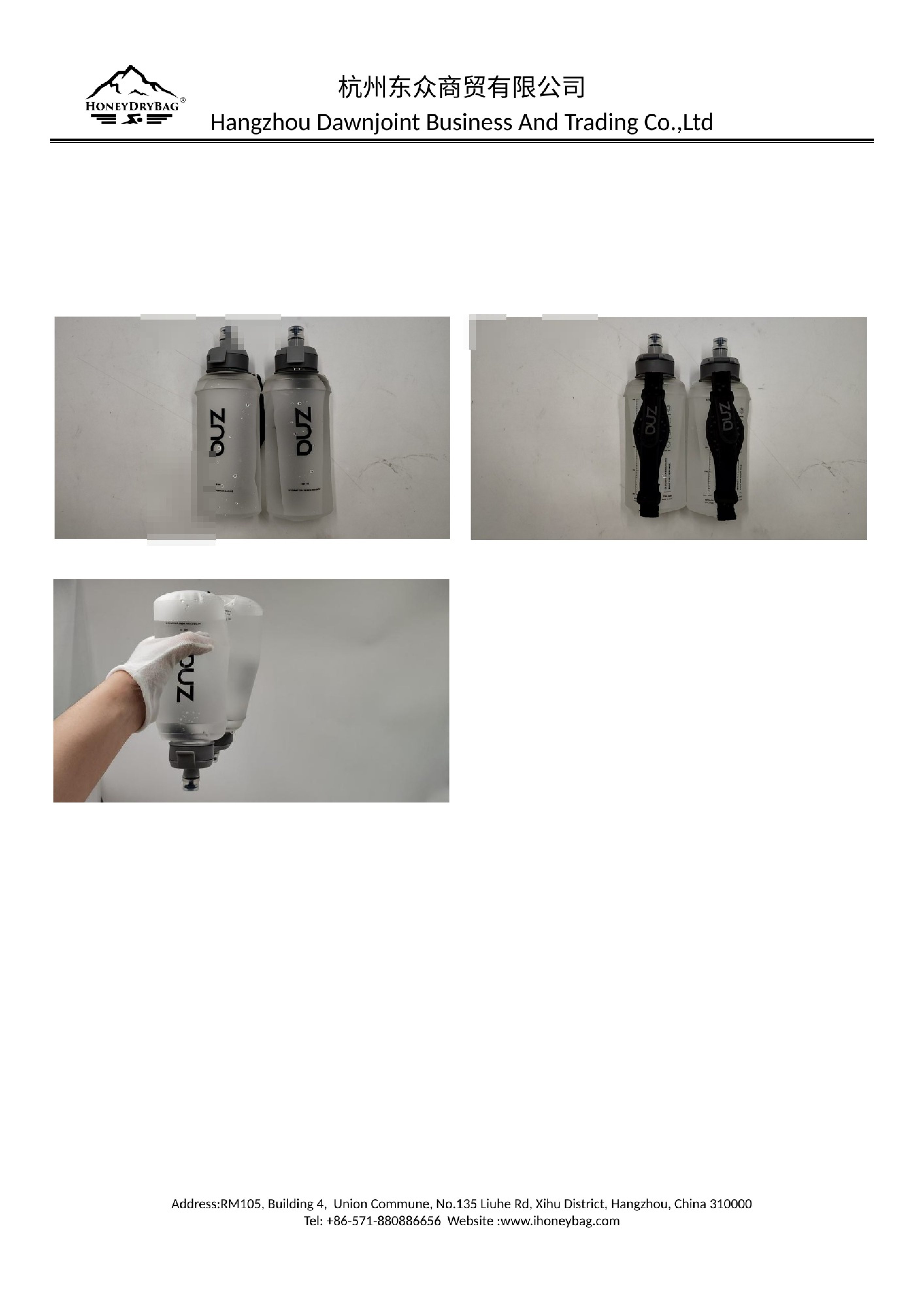
The acceptance criterion in the report was straightforward:
No leakage = qualified
Leakage = unqualified
For the inspected samples, the recorded result was:
No water leakage.
The final inspection conclusion was:
QUALIFIED
Soft Flask With Strap vs Standard Running Vest Soft Flask
The addition of a hand strap does not automatically make one configuration better than another.
They solve different carrying requirements.
A standard soft flask is commonly suitable when the product is intended to sit inside a running vest pocket.
A soft flask with a hand strap can be considered when handheld hydration is part of the intended use.
For a brand developing its own hydration product, the decision should start with the intended user and application.
Questions worth considering include:
How will the runner carry the flask?
Inside a vest or directly in the hand?
How much capacity is required?
Short training sessions may have different hydration requirements from long-distance trail running.
How important is total product weight?
Additional straps and accessories can change the final weight.
Does the strap need to be adjustable?
Different hand sizes and intended applications may require different configurations.
Will the product also be used in a running vest?
If so, the additional component should not interfere with pocket compatibility.
What B2B Buyers Should Check on a Customized Sample
When developing a custom soft flask with additional accessories, we recommend evaluating the complete product rather than checking the bottle alone.
A practical sample review can include:
Flask
- Capacity
- Length
- Width
- Body shape
- Material
- Cap
- Bite valve
Hand Strap or Accessory
- Position
- Size
- Adjustment
- Attachment method
- Comfort
- Added weight
Branding
- Logo position
- Logo size
- Printing appearance
- Printing adhesion
Function
- Water leakage
- Compression
- Drinking performance
- Carrying stability
- Intended-use compatibility
The appropriate checklist depends on the final product design.
Why We Publish Real Customer Sample Inspections
It is easy for a supplier website to say:
"OEM available."
"Strict quality control."
"Professional soft flask manufacturer."
But those statements provide limited evidence by themselves.
For this reason, Farhview.com is gradually documenting actual soft flask development and inspection work.
This case includes:
- A real internal sample report
- A real inspection date
- Actual customer samples
- Actual weight measurement
- Actual dimension measurement
- Printing adhesion testing
- Material and construction inspection
- Water leakage testing
- A recorded inspection conclusion
Customer names, order numbers and customer branding are redacted before publication to protect commercial confidentiality.
What This Report Does Not Claim
This report documents a specific customer sample inspection.
It does not mean that:
- Every soft flask with a strap weighs 140g
- Every soft flask measures 22 × 8cm
- Every handheld flask uses the same construction
- One sample inspection guarantees every future production unit
- An internal QC report replaces independent laboratory testing
The measurements and observations in this article apply to the samples documented in this particular report.
This distinction is important when using real manufacturing data.
Final Inspection Result
For this project, the report recorded:
Quantity: 2
Sampling quantity: 2
Weight: 140g
Dimensions: 22 × 8cm
Printing: No colour loss or decoloration observed
Material and construction: No cracking observed in the inspected areas
Water leakage: No leakage observed
Final conclusion: QUALIFIED
This provides another real example of how a customized soft flask configuration can be physically checked before a customer project moves forward.
Developing a Custom Soft Flask?
Honey Dry Bag works with B2B buyers on TPU soft flask products for running, trail running, endurance sports and outdoor hydration applications.
Depending on the project, customization can involve:
- Flask capacity
- Product dimensions
- Logo printing
- Product colors
- Cap configuration
- Bite valves
- Hand straps
- Additional carrying components
- Packaging
- Sample development
- OEM and ODM requirements
If you are developing a custom soft flask, contact us with your intended application, target capacity, estimated quantity, destination market and customization requirements.
We can discuss suitable existing models and whether additional components such as a hand strap are appropriate for your project.