Quick answer: Before moving a custom soft flask project toward bulk production, a physical sample should be checked against the agreed product requirements.
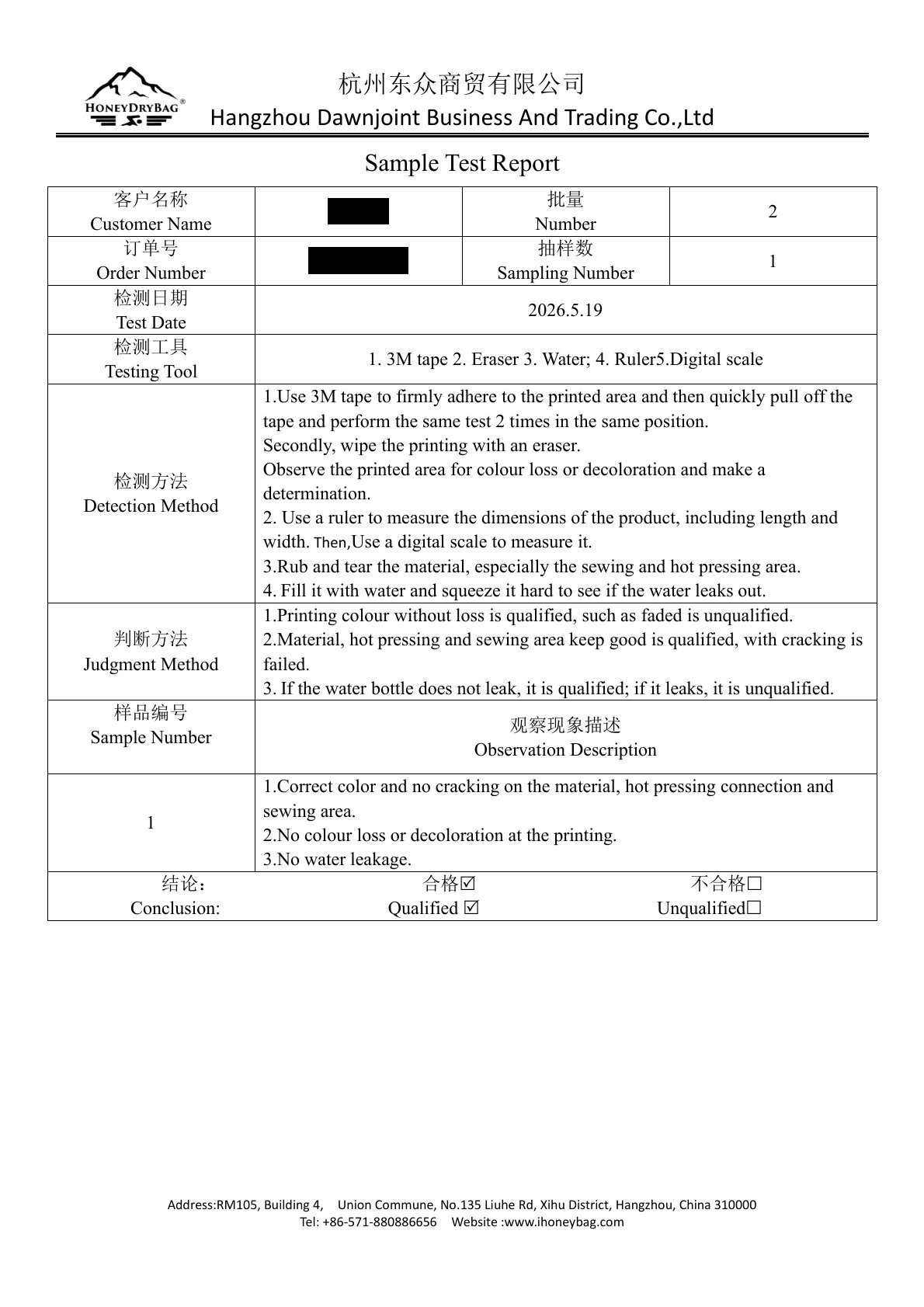
In one actual customer project, our team inspected a customized soft flask for dimensions, weight, printing adhesion, material and construction condition, and water leakage.
This article documents that real sample inspection.
The test was performed on May 19, 2026 by Hangzhou Dawnjoint Business And Trading Co., Ltd. / Honey Dry Bag.
Customer-identifying information, order information and customer branding have been redacted from the public images to protect commercial confidentiality.
Why Test a Custom Soft Flask Sample Before Bulk Production?
For an OEM soft flask project, receiving a sample is not simply an opportunity to check whether the product looks good.
It is an opportunity to verify whether the physical product matches the requirements agreed during development.
A customized soft flask can involve several variables:
- Flask dimensions
- Product weight
- Body color
- Logo printing
- Cap and valve configuration
- Material construction
- Leakage performance
Problems discovered during the sample stage can be discussed and corrected before larger-scale production begins.
That is why we treat sample approval as a product-verification step rather than only a visual confirmation.
A Real OEM Soft Flask Sample Inspection
For the customer project documented here, the report recorded:
Test date: May 19, 2026
Order quantity: 2
Sampling quantity: 1
Testing tools:
- 3M tape
- Eraser
- Water
- Ruler
- Digital scale
The inspection focused on practical characteristics of the finished customized sample.
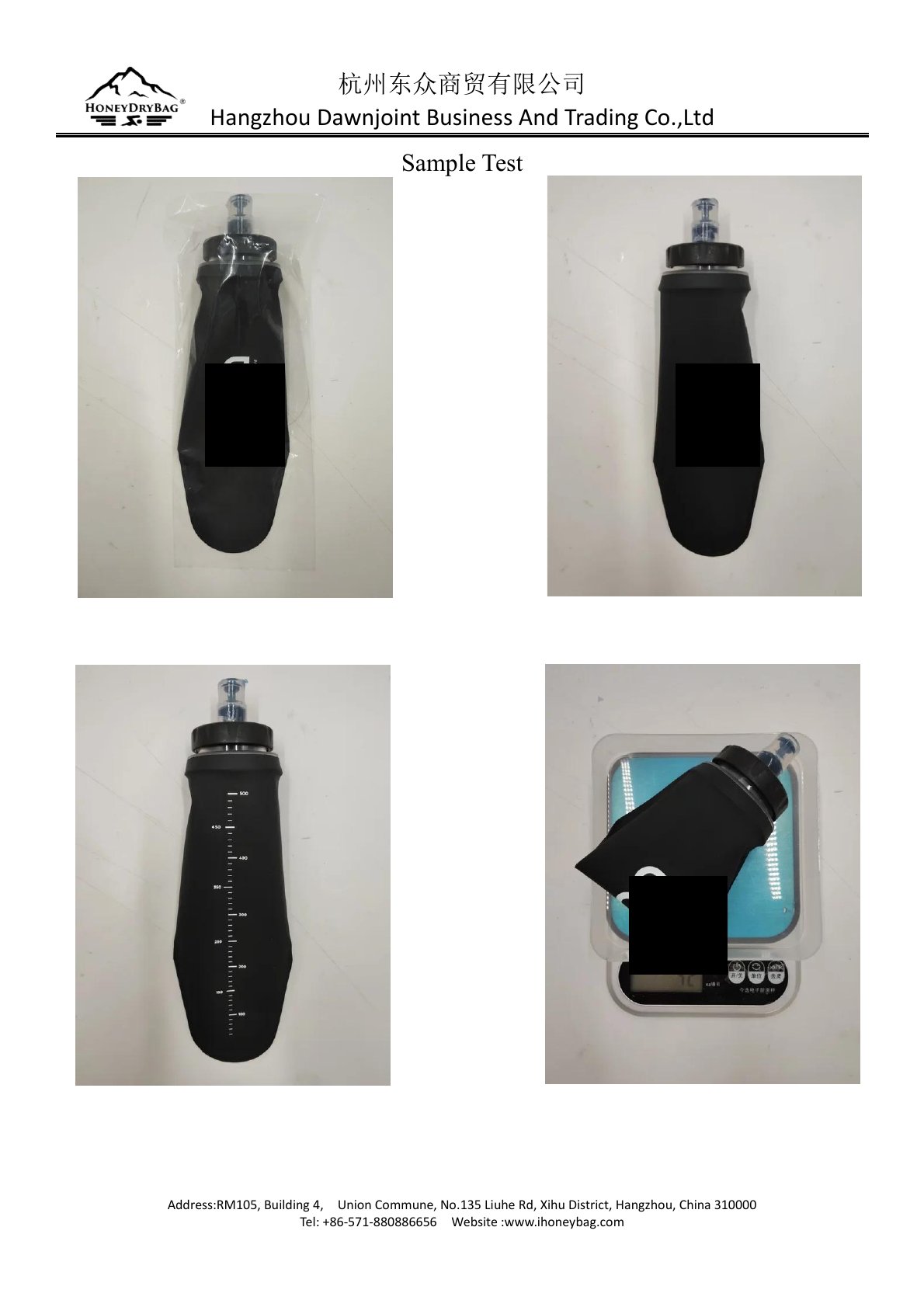
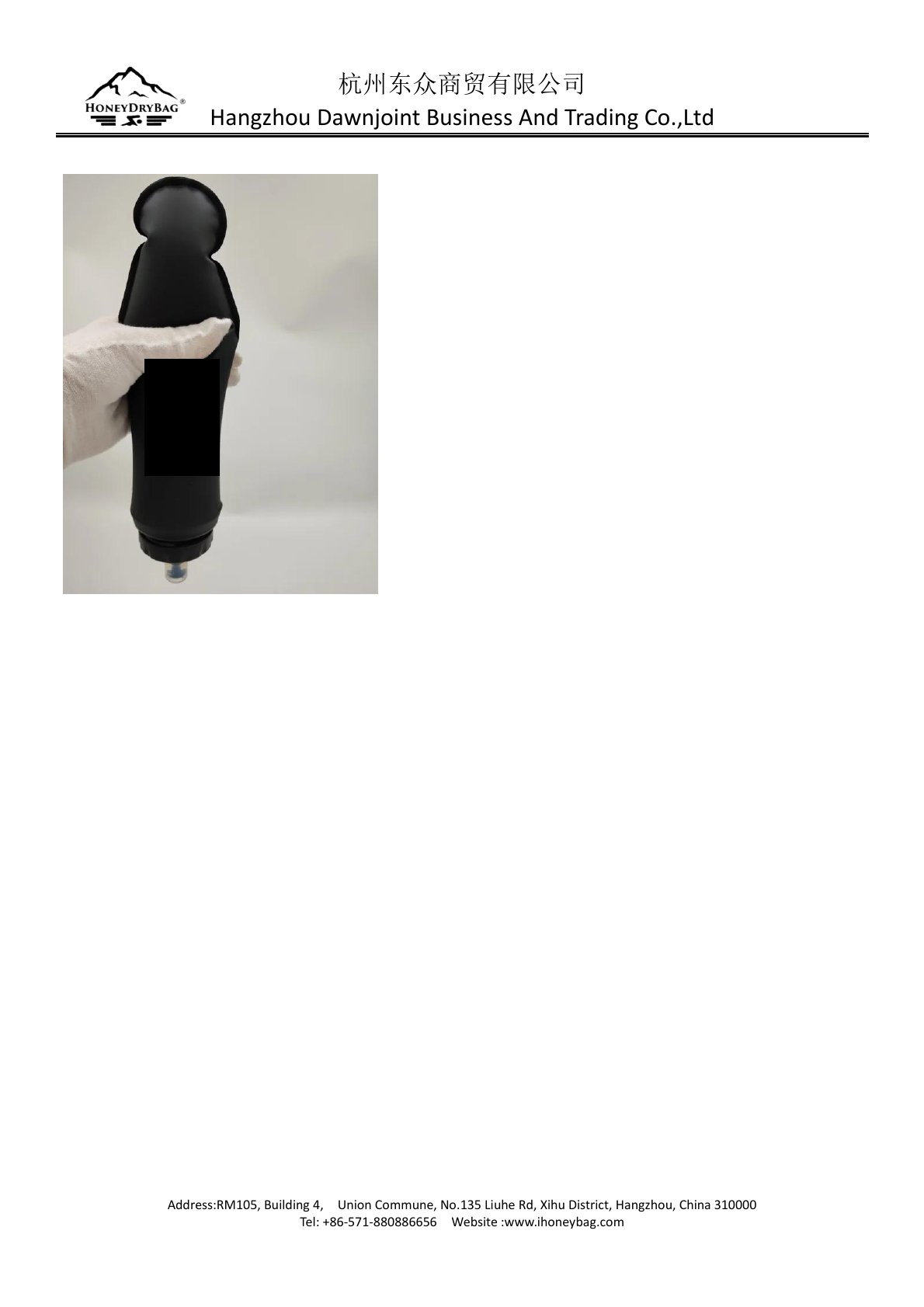
The photographs above come from the actual sample inspection documented in this report. Customer branding has been redacted from the public version.
1. Checking the Actual Sample, Dimensions and Weight
The first step is to inspect the physical product rather than relying only on specifications provided before sampling.
For this project, the sample was photographed and weighed using a digital scale.
Its physical dimensions were also checked using a ruler.
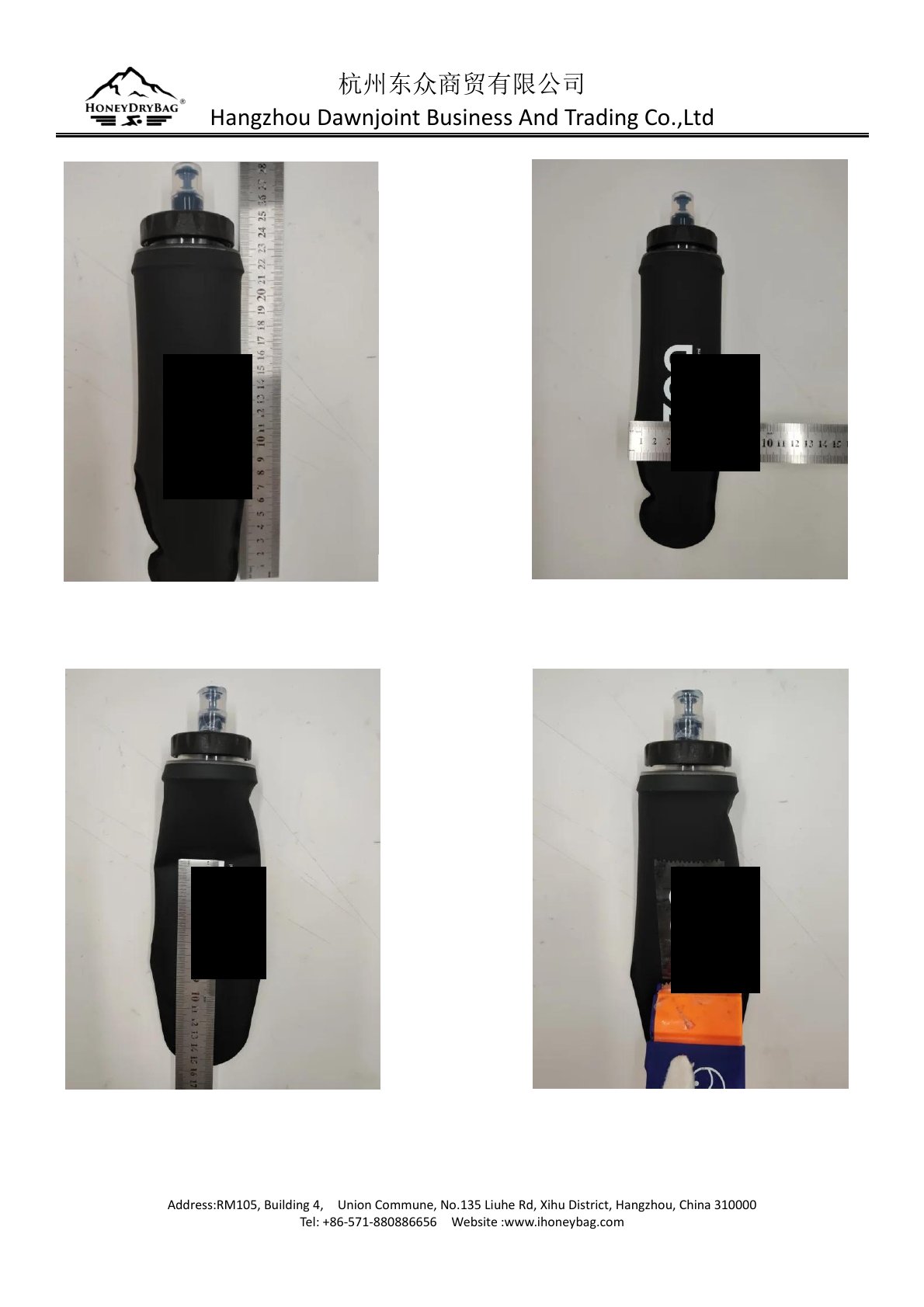
This matters because nominal capacity alone does not describe the complete geometry of a soft flask.
For example, two soft flasks may both have the same nominal capacity but differ in:
- Length
- Width
- Overall profile
- Neck dimensions
- Weight
For running and trail-running products, these differences can affect compatibility with running vest pockets, hydration belts and other carrying systems.
A physical custom sample therefore gives the buyer an opportunity to confirm important product characteristics before the project moves forward.
2. Testing Custom Logo Printing
For private-label and OEM products, the customer's logo is part of the finished product specification.
A print may look correct immediately after production but still require an adhesion check.
In this sample inspection, 3M tape was firmly applied to the printed area and quickly removed.
The same test was performed twice at the same position.
The printing was also wiped with an eraser and inspected for color loss or decoloration.
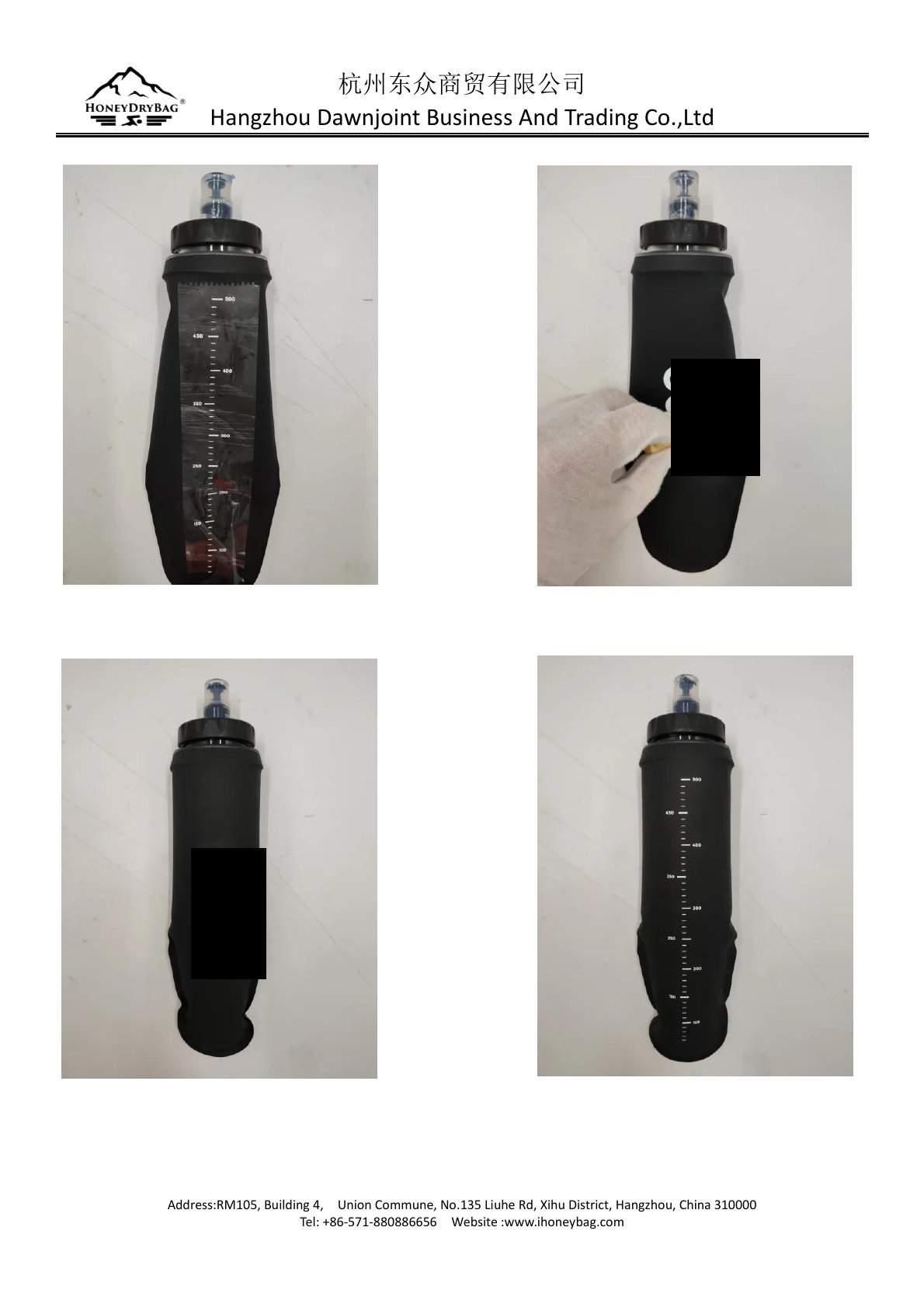
The report defined printing without color loss as qualified.
For the inspected sample, the recorded observation was:
No colour loss or decoloration at the printing.
This provides a practical check of the customized printing before the project moves toward bulk production.
3. Checking Material and Construction
A soft flask is repeatedly deformed during normal use.
Depending on how it is used, it may be:
- Filled
- Squeezed
- Bent
- Compressed
- Inserted into a running vest
- Removed from a pocket
- Emptied
- Refilled
For this reason, sample inspection should include more than surface appearance.
During this inspection, the material was rubbed and pulled, with attention to the material and relevant connection areas.
The observation recorded in the report was:
Correct color and no cracking on the material, hot pressing connection and sewing area.
This result applies specifically to the sample inspected in this project.
It should not be interpreted as a universal performance claim for every product or future production batch.
4. Testing the Soft Flask for Water Leakage
Leakage is one of the most important functional checks for a soft flask.
For this inspection, the sample was filled with water and squeezed firmly to check whether water leaked from the product.
The report used a straightforward acceptance criterion:
No leakage = qualified.
Leakage = unqualified.
For this inspected sample, the recorded observation was:
No water leakage.
The final inspection conclusion recorded in the report was:
QUALIFIED.
What This Real Sample Test Tells a B2B Buyer
This case demonstrates why an OEM sample should be treated as more than a sales sample.
A physical sample gives the buyer and supplier an opportunity to evaluate actual product characteristics before moving toward larger production quantities.
Depending on the project, a buyer may want to confirm:
- Actual dimensions
- Actual weight
- Product color
- Logo position
- Printing quality
- Printing adhesion
- Material condition
- Construction
- Leakage
- Cap and valve performance
- Compatibility with the intended running vest or hydration system
Not every custom soft flask project requires exactly the same inspection process.
The appropriate checks depend on the product specification, customization and buyer requirements.
What This Report Does — and Does Not — Prove
We believe real manufacturing evidence should also clearly explain its limitations.
This report documents one sampled product from one customer project.
It demonstrates how this particular sample was inspected and what observations were recorded during that inspection.
It does not mean that one sample result automatically guarantees every future production unit.
The report is also an internal sample quality-control record.
It is not an independent regulatory, chemical or food-contact laboratory certificate.
If a project requires specific food-contact, chemical or regulatory testing, those requirements should be evaluated separately according to the product and destination market.
Internal sample inspection and independent laboratory testing serve different purposes.
A Practical Custom Soft Flask Sample Approval Checklist
For B2B buyers developing a custom soft flask, we recommend defining the important specifications before approving the sample.
A practical checklist may include:
Product
- Capacity
- Dimensions
- Weight
- Color
- Overall appearance
Customization
- Logo size
- Logo position
- Printing quality
- Printing adhesion
Construction
- Material condition
- Hot-pressed or welded areas
- Neck connection
- Cap
- Bite valve
Function
- Water leakage
- Drinking performance
- Compression
- Fit with the intended running vest or hydration belt
The exact checklist should be adjusted according to the product and project.
Once the important points have been confirmed, the approved sample can provide a clearer physical reference for the next stage of production.
Why We Publish Real Sample Testing
Many supplier websites use similar statements:
"Strict quality control."
"Professional manufacturing."
"High-quality products."
Those statements alone provide limited information about what actually happens during a customer project.
We want Farhview.com to increasingly show first-hand evidence from our real soft flask work.
That includes:
- Real customer sample inspections
- Real product measurements
- Real leakage tests
- Real printing tests
- Real QC reports
- Material and construction checks
- OEM and ODM development examples
Where a real customer project is shown publicly, identifying information and commercially sensitive information will be removed or redacted.
Where a test result comes from one specific sample, we will identify it as a sample result rather than presenting it as a universal product claim.
The goal is simple:
Give B2B buyers more evidence about how an actual soft flask project is evaluated before production.
Final Result of This Custom Soft Flask Sample
For the sample documented in this report, the recorded observations included:
- Correct color
- No cracking observed in the material and relevant connection areas
- No color loss or decoloration observed in the printing
- No water leakage observed
The final recorded conclusion was:
QUALIFIED
This is one real example of how a customized soft flask sample was inspected before customer approval.
Developing a Custom Soft Flask for Your Brand?
Honey Dry Bag works with B2B buyers on custom TPU soft flask projects for running, trail running, endurance sports and outdoor hydration applications.
Depending on the project, customization can involve:
- Capacity
- Product dimensions
- Logo printing
- Product color
- Cap and valve configuration
- Packaging
- Sample development
- OEM and ODM requirements
- Product inspection requirements
If you are developing a custom soft flask, contact us with your intended application, target capacity, estimated order quantity, destination market and customization requirements.
We can discuss suitable existing models and the next step for sample development.