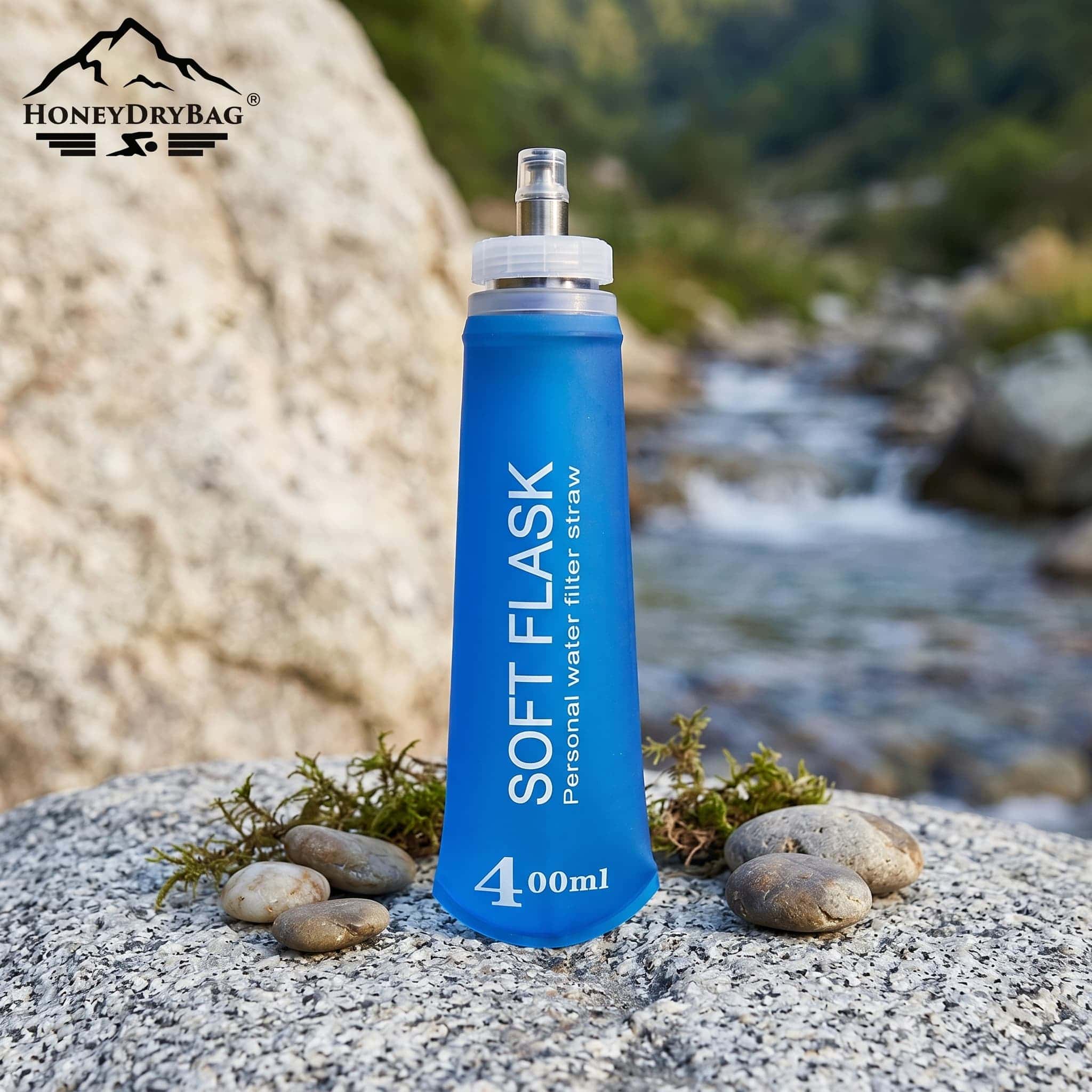
Quick answer: A soft flask works by using a flexible bottle body that changes shape as you drink. Instead of maintaining a fixed shape like a rigid water bottle, the flask gradually compresses as liquid leaves it. Many running soft flasks also use a bite valve, allowing the runner to drink by biting and drawing or squeezing liquid through the valve.
This simple design is one reason soft flasks are widely used with running vests, trail-running equipment and other compact hydration systems.
What Is a Soft Flask?
A soft flask is a flexible container designed to carry water or other suitable hydration liquids.
Unlike a traditional rigid bottle, its body can:
- Bend
- Compress
- Collapse
- Change shape as liquid is consumed
Many running soft flasks use a flexible TPU body combined with a cap and bite valve.
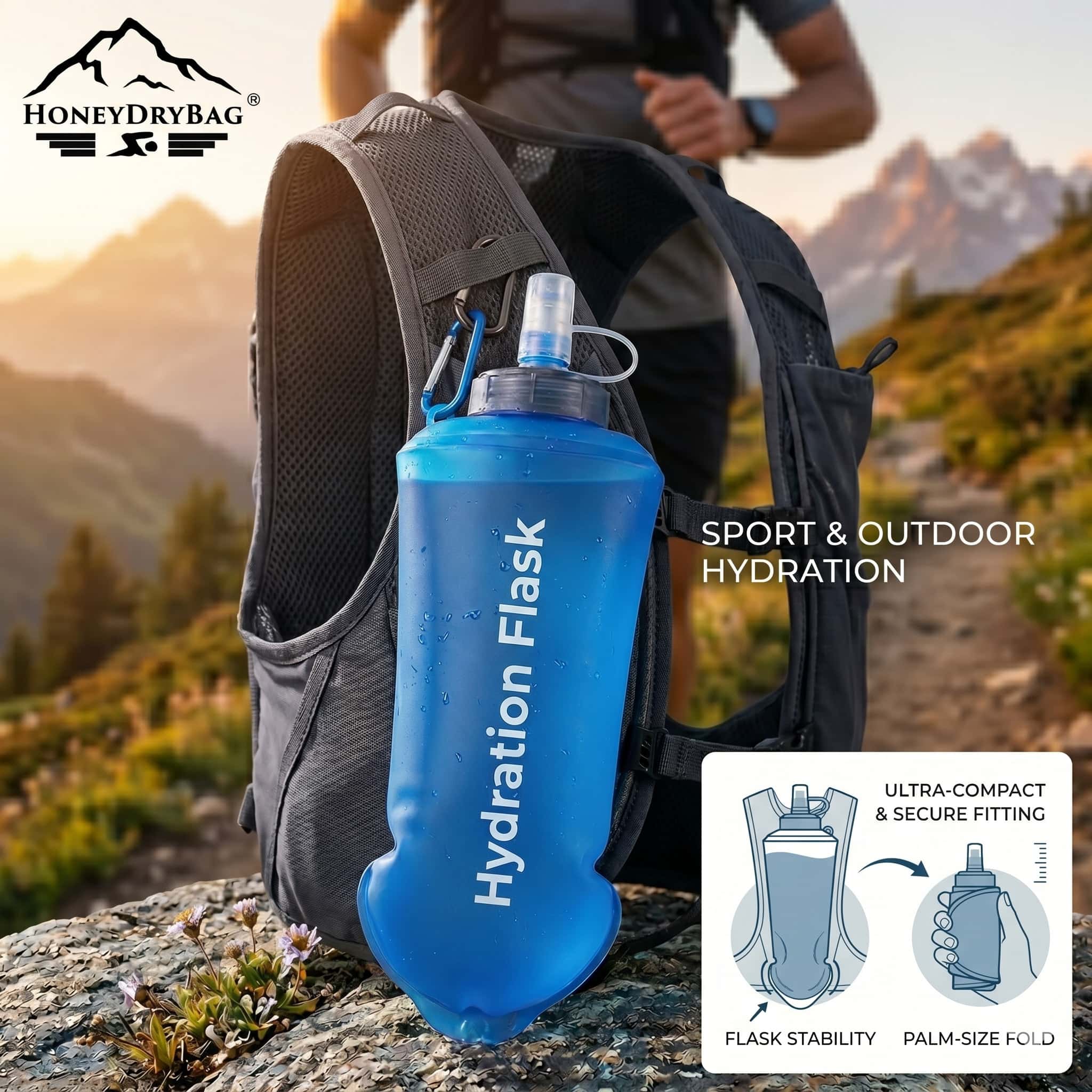
Soft flasks are commonly associated with:
- Running
- Trail running
- Ultramarathons
- Hiking
- Endurance sports
- Hydration vests
The basic idea is simple:
carry liquid when you need it and reduce the container's volume as you drink.
How Does a Soft Flask Work?
A soft flask has several components that work together.
A typical configuration includes:
- A flexible flask body
- A neck opening
- A cap
- A drinking nozzle or bite valve
The flexible body stores the liquid.
The cap seals the main opening.
The bite valve provides a controlled drinking point.
When liquid leaves the flask, the flexible body can contract instead of requiring the container to maintain a fixed internal volume.
That is the fundamental difference between a soft flask and most rigid water bottles.
Why Does a Soft Flask Shrink as You Drink?
Imagine drinking from a conventional rigid bottle.
The bottle keeps approximately the same external dimensions whether it contains:
500ml
or
100ml
The unused part of the bottle still occupies space.
A soft flask behaves differently.
As the amount of liquid decreases, the flexible walls can move inward.
The flask therefore becomes progressively smaller.
When empty, many soft flasks can be flattened or rolled into a much smaller volume.
This is one reason a soft flask can also fall within the broader category of a collapsible water bottle.
How Does a Soft Flask Bite Valve Work?
Many running soft flasks do not use the same drinking opening as an everyday water bottle.
Instead, they use a bite valve.
A bite valve is designed to help control the flow of liquid from the flask.
Depending on the valve design, the runner typically places the valve in the mouth, bites or compresses the valve and drinks while applying suction or pressure to the flask.
When the valve is not being used, its design helps restrict uncontrolled flow.
This makes a bite valve useful for running because the user does not necessarily need to:
- Unscrew the cap
- Remove the entire lid
- Tilt a rigid bottle
- Stop running to drink
Actual valve operation can vary between different soft flask designs, so the manufacturer's instructions should always be followed for a particular product.
Why Are Soft Flasks Popular for Running?
The main reason is that their physical characteristics work well with many running hydration systems.
Flexible Shape
The bottle can deform rather than maintaining a completely rigid structure.
Compressibility
The flask becomes smaller as liquid is consumed.
Front-Pocket Hydration
Many running vests have front pockets designed for soft flasks.
Accessible Drinking
A sufficiently high bite valve can allow some runners to drink without completely removing the flask from the vest.
Multiple Capacities
Soft flasks can be produced in different capacities for different hydration requirements.
These characteristics make them particularly relevant to trail running and endurance sports.
What Is TPU in a Soft Flask?
TPU stands for thermoplastic polyurethane.
It is a flexible polymer used in many applications where properties such as flexibility and durability are useful.
In a soft flask, flexible TPU construction allows the body to bend and compress instead of behaving like a conventional rigid bottle.
However, simply saying that a product uses TPU does not tell you everything about the finished flask.
The complete product can also be affected by:
- Material formulation
- Film construction
- Manufacturing process
- Welded or heat-pressed areas
- Cap design
- Valve design
- Product dimensions
For B2B buyers, the finished product and its intended application should therefore be evaluated rather than relying only on the material name.
Does a Soft Flask Let Air Inside?
This is an important difference between flexible and rigid hydration containers.
A rigid bottle generally needs to deal with the space created as liquid leaves the container.
A flexible flask can reduce its internal volume because the walls move inward as the liquid is consumed.
This behavior is one reason soft flasks can feel different from conventional rigid bottles during running.
The exact behavior still depends on the flask, valve and drinking system.
Why Doesn't a Soft Flask Keep Its Shape?
Because it is not designed to.
A soft flask uses flexibility as part of its function.
When completely filled, the liquid inside helps give the flask its shape.
As the liquid level falls, the body can become softer and more compressed.
When empty, the flask may appear almost flat.
This is normal behavior for a flexible hydration container.
It should not be confused with the structural behavior expected from a rigid water bottle.
Soft Flask vs Collapsible Water Bottle
The terms are related, but they are not always identical.
A collapsible water bottle is a broad category describing a bottle that can reduce in size for storage.
A soft flask is generally a more specialized flexible hydration format and is commonly associated with sports applications.
For example, a running soft flask may have:
- A narrow body
- Bite valve
- Running vest compatibility
- Flexible TPU construction
- Sports-oriented capacity
A general collapsible bottle designed for travel may use a completely different shape and drinking system.
Therefore:
Many soft flasks are collapsible bottles, but not every collapsible water bottle is necessarily a running soft flask.
What Happens When a Soft Flask Is Empty?
One of the practical characteristics of a soft flask becomes most obvious when there is no liquid left.
An empty soft flask can usually be compressed considerably.
Depending on the construction, it may be:
- Flattened
- Folded
- Rolled
- Stored inside a pocket or pack
This can make it useful for runners and outdoor users who want to reduce the amount of space occupied by empty hydration equipment.
Before folding or storing a flask for a long period, however, it should normally be cleaned and thoroughly dried according to the product's care instructions.
How Do You Fill a Soft Flask?
The exact process depends on the product, but a typical soft flask uses a removable cap.
The basic process is:
- Open the cap.
- Add water or the intended hydration liquid.
- Avoid exceeding the product's intended capacity.
- Securely close the cap.
- Check the closure before placing the flask in a running vest.
- Test the drinking valve before starting your activity.
Because the body is flexible, holding the flask near the neck can make filling easier.
Always follow the instructions supplied with the particular flask.
Why Can Two 500ml Soft Flasks Look Different?
Capacity describes the amount of liquid a flask is designed to hold.
It does not completely describe the shape of the product.
Two 500ml soft flasks may have different:
- Lengths
- Widths
- Neck diameters
- Body profiles
- Cap sizes
- Valve positions
Both can still have the same nominal capacity.
This is particularly important when selecting a soft flask for a running vest.
A 500ml label alone does not guarantee that the flask will fit every 500ml-compatible-looking pocket.
How Does a Soft Flask Fit in a Running Vest?
Many running vests position soft flask pockets on the front shoulder or chest area.
The flask is inserted into the pocket with the drinking valve positioned toward the top.
A good combination depends on both products.
Important factors include:
- Flask length
- Flask width
- Pocket depth
- Pocket elasticity
- Valve position
- Filled flask shape
A flask that is too short may place the valve too low.
A flask that is too large may be difficult to insert.
For brands developing running equipment, it can therefore be useful to test the physical soft flask and running vest together.
250ml, 350ml or 500ml: Does the Mechanism Change?
The basic principle remains similar.
What changes is primarily the amount of liquid carried and the physical dimensions required to contain it.
250ml Soft Flask
Useful when compact size and smaller quantities of liquid are priorities.
350ml Soft Flask
Provides a middle capacity between smaller and larger running flasks.
500ml Soft Flask
Offers greater hydration capacity and is commonly considered for running vest applications.
The right capacity depends on the intended activity rather than the operating mechanism of the flask.
What Should You Look for in a Running Soft Flask?
Understanding how a soft flask works makes it easier to compare products.
Instead of looking only at capacity, consider:
Capacity
How much liquid do you need to carry?
Dimensions
Will the flask fit your running vest?
Valve
Is the drinking system appropriate for your intended use?
Cap
Is the opening practical for filling and cleaning?
Construction
Are the flexible body and connection areas suitable for the intended application?
Weight
What is the finished weight of the complete configuration?
Cleaning
Can the product be cleaned and dried conveniently?
Different runners and different running vests may require different configurations.
What Should B2B Buyers Consider?
For brands sourcing custom soft flasks, understanding the mechanism is only the starting point.
A commercial project may also require decisions about:
- Capacity
- Dimensions
- TPU construction
- Cap configuration
- Bite valve
- Product color
- Logo printing
- Packaging
- Running vest compatibility
A physical sample can also help verify the actual finished product before bulk production.
Depending on the project, sample inspection can include characteristics such as:
- Weight
- Dimensions
- Printing
- Construction
- Leakage
- Compatibility
This is especially important when the soft flask is intended to work as part of a complete running hydration system.
Final Thoughts
A soft flask works because its flexible construction allows the container to change with the liquid inside it.
When full, the liquid helps expand the flask.
As you drink, the flexible body contracts.
When empty, the flask can occupy substantially less space than a conventional rigid bottle.
Combined with a bite valve and a suitable running vest, this makes the soft flask a practical hydration format for running, trail running and endurance activities.
The key point is simple:
A soft flask is not just a softer version of a water bottle. Its flexibility is part of how the hydration system works.
Looking for a Custom TPU Soft Flask?
Honey Dry Bag focuses on TPU soft flask products for running, trail running, endurance sports and outdoor hydration applications.
For B2B projects, different configurations can be discussed according to the intended application, including:
- 250ml, 350ml and 500ml capacities
- Custom dimensions
- TPU construction
- Product colors
- Logo printing
- Caps
- Bite valves
- Packaging
- OEM and ODM requirements
If you are developing a soft flask or running hydration product, contact us with your target capacity, application, estimated quantity and customization requirements.
We can discuss a suitable existing model or customization direction for your project.