Quick answer: TPU can be suitable for drinking-water products when the specific TPU formulation and finished food-contact components are designed and verified for that use. However, TPU is a broad family of thermoplastic polyurethane materials, so buyers should not assume that every TPU grade is automatically suitable for drinking water.
For a TPU soft flask or collapsible water bottle, the important question is not simply "Is TPU safe?" It is whether the specific material, additives, manufacturing process, and finished product are appropriate for food-contact use and supported by the documentation required for the target market.
For B2B buyers, this distinction is especially important when sourcing running soft flasks, hydration bottles, and custom TPU water containers.
What Is TPU?
TPU stands for thermoplastic polyurethane.
It is a flexible thermoplastic material used across many industries because different TPU formulations can provide combinations of:
- Flexibility
- Elasticity
- Abrasion resistance
- Tear resistance
- Transparency
- Low-temperature flexibility
- Repeated bending performance
In hydration products, TPU is commonly used to manufacture flexible components such as:
- Running soft flasks
- Collapsible water bottles
- Hydration reservoirs
- Flexible water containers
Unlike a rigid bottle, a TPU soft flask can compress as the user drinks and occupy less space as it becomes empty.
This makes TPU particularly useful for running, trail running, triathlon, cycling, hiking, and other applications where lightweight and compressible hydration equipment is useful.
Is TPU Safe to Drink From?
The accurate answer is:
The suitability of TPU for drinking-water contact depends on the specific TPU formulation and finished product.
"TPU" describes a family of materials rather than one universal formulation.
Different TPU grades can contain different raw materials, additives, pigments, processing aids, and performance characteristics.
A TPU developed for an industrial component should therefore not automatically be treated as equivalent to a TPU selected for a drinking-water product.
For a soft flask, buyers should verify that the materials used for the relevant food-contact components are appropriate for their intended application.
This includes more than the flexible body.
Depending on the product design, water may also contact:
- The bottle neck
- Cap
- Bite valve
- Internal seals
- Other drinking-system components
A complete product evaluation should therefore consider all relevant food-contact components.
Is All TPU Food Safe?
No.
It is not accurate to say that all TPU is food safe.
TPU is used in many applications that have nothing to do with food or drinking water.
The suitability of a particular TPU material depends on factors such as:
- Material formulation
- Additives
- Pigments
- Intended use
- Contact conditions
- Manufacturing process
- Applicable regulatory requirements
This is why B2B buyers should avoid relying only on supplier statements such as:
"Made from TPU."
That tells you what general material family is being used, but it does not by itself establish suitability for a particular food-contact application.
A stronger sourcing process asks:
Which TPU grade is used, and what supporting documentation is available for the intended application and destination market?
What Does "Food-Grade TPU" Mean?
"Food-grade TPU" is commonly used as a commercial description for TPU materials intended for food-contact applications.
However, buyers should not rely on the phrase alone.
A supplier describing a soft flask as "food grade" should be able to provide relevant information or documentation for the material or finished product when required.
For B2B sourcing, useful questions include:
- What TPU material is used?
- Is it intended for food-contact applications?
- What supporting documentation is available?
- Which product components are covered?
- Does the documentation correspond to the actual material being supplied?
- Is additional finished-product testing required for the target market?
The objective is to connect the marketing claim with verifiable product information.
Is TPU BPA-Free?
BPA and TPU are not the same thing.
BPA, or bisphenol A, is associated with certain polymer and resin systems, while TPU refers to thermoplastic polyurethane.
However, a buyer should still avoid assuming that every complete TPU hydration product automatically meets a particular BPA requirement simply because the main body is made from TPU.
A finished soft flask can contain several materials:
- TPU film
- Cap material
- Valve material
- Seals
- Pigments
- Printing materials
If a brand intends to market a product with a specific BPA-related claim, it should obtain appropriate supporting information or testing for the relevant product and market.
What Should B2B Buyers Request From a TPU Soft Flask Supplier?
For wholesale, OEM, and private-label projects, material verification should be part of supplier qualification.
Depending on the destination market and buyer requirements, buyers may discuss documentation or testing related to:
- Food-contact requirements
- Material composition
- BPA
- Phthalates
- REACH restricted substances
- Relevant EU food-contact requirements
- LFGB testing where applicable or requested
- Relevant US food-contact requirements
- Third-party laboratory testing
The exact documents required depend on the destination market, product construction, intended use, and the buyer's own compliance program.
A certificate should also be checked for relevance.
For example, buyers should confirm:
- Which material or product was tested?
- Does the report correspond to the material currently being supplied?
- Which standard or requirement was used?
- Which components are covered?
- Is the report still relevant to the current product specification?
Simply receiving a PDF labeled "test report" is not enough.
TPU Material vs Finished Soft Flask
This distinction is important.
A raw TPU film may have supporting material documentation, but the finished soft flask contains more than the film.
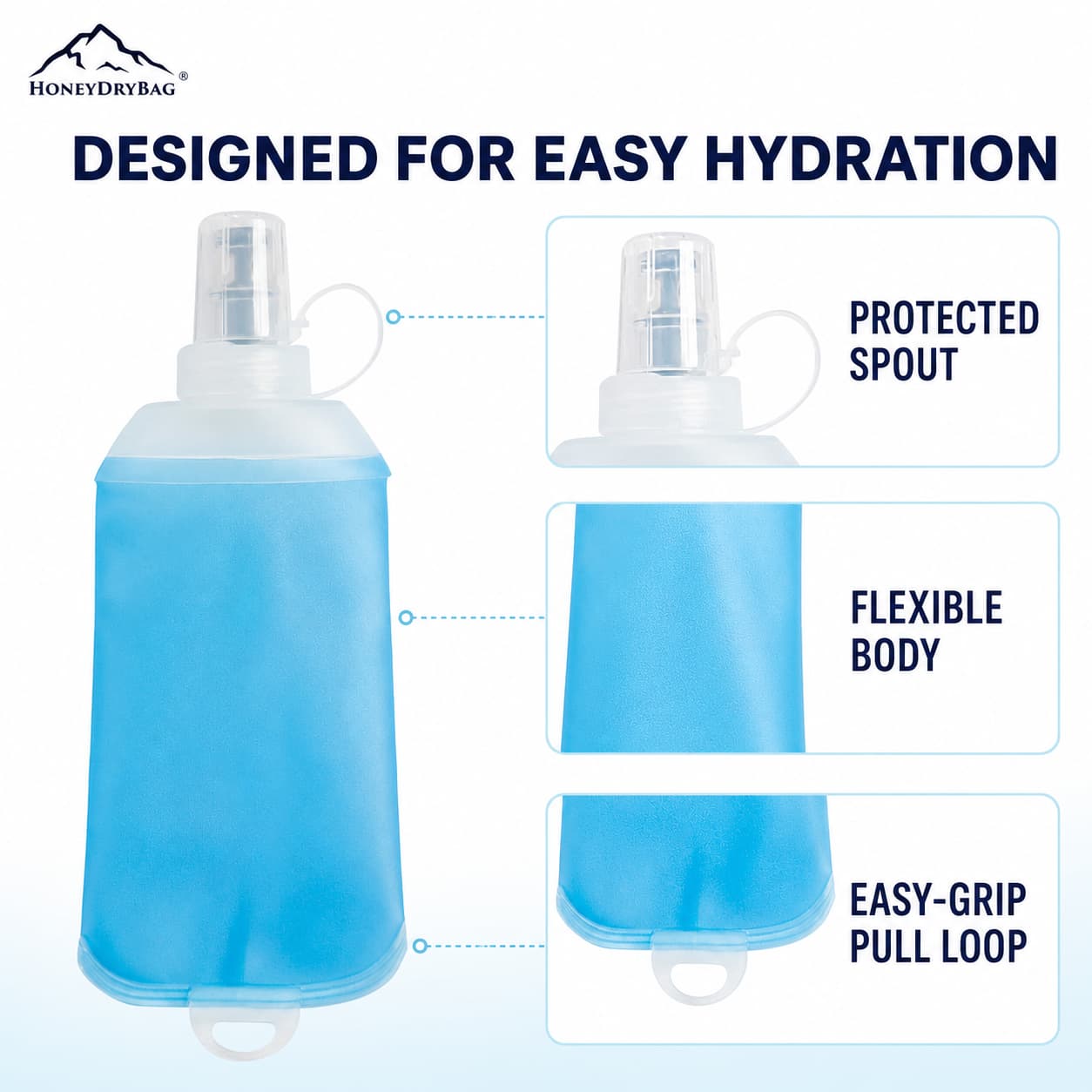
A typical running soft flask may include:
Flexible body
Usually the primary TPU component.
Neck
Connects the flexible body to the cap system.
Cap
May use a different polymer from the bottle body.
Bite valve
Can contain different flexible materials depending on the design.
Seal
May use another material to prevent leakage.
Printing
Logo or graphic printing introduces additional materials and manufacturing processes.
For that reason, B2B buyers should evaluate the finished product configuration, not only the TPU film.
Does TPU Give Water a Plastic Taste?
A plastic or chemical taste does not automatically mean that TPU itself is unsafe.
Taste and odor can be influenced by several factors, including:
- Material formulation
- Manufacturing residue
- Packaging
- Storage conditions
- New-product odor
- Cleaning
- Sports drink residue
- Cap or valve materials
New soft flasks should normally be cleaned according to the manufacturer's instructions before first use.
For brands, taste and odor should also be evaluated during sample testing.
If a product produces persistent or unusual taste or odor, the issue should be investigated rather than dismissed as a normal characteristic of every TPU product.
Is TPU Better Than Silicone for Drinking Water?
There is no universal answer.
Both TPU and silicone can be used in products intended for food or beverage applications when appropriate materials and product designs are selected.
The materials have different characteristics.
TPU
TPU is particularly useful for lightweight flexible-film products such as running soft flasks and hydration reservoirs.
Potential product advantages include:
- Thin flexible construction
- Low empty weight
- Compressibility
- Abrasion resistance
- Compatibility with welded soft-flask construction
Silicone
Silicone is widely used in food-contact products and can provide:
- High flexibility
- Temperature stability
- Soft hand feel
- Different molding possibilities
However, silicone bottles can have different wall thickness, weight, structural behavior, manufacturing processes, and carrying characteristics from TPU running soft flasks.
For a running hydration product, the better material depends on the intended design and use case rather than a general claim that one material is always safer or better.
Is TPU Suitable for Hot Water?
Do not assume that every TPU soft flask is designed for hot water.
Temperature suitability depends on:
- TPU formulation
- Bottle construction
- Cap
- Valve
- Seals
- Manufacturer specifications
- Intended use
A running soft flask designed for normal hydration should not automatically be treated as a hot-water container.
Brands planning a product for elevated-temperature liquids should define this requirement before production and verify the complete product accordingly.
Consumers should follow the temperature guidance provided for the specific product.
Can TPU Be Used for Sports Drinks?
A suitable soft flask may be used with sports drinks or electrolyte mixes when the product manufacturer supports that use.
However, sports drinks introduce additional considerations compared with plain water.
Sugars, carbohydrates, flavorings, and electrolytes can leave residue inside:
- The flask body
- Cap
- Threads
- Bite valve
This makes cleaning and drying particularly important.
Brands targeting endurance athletes should therefore test the bottle not only with water but also with the types of drinks their customers are likely to use.
Product testing can include:
- Taste
- Odor
- Leakage
- Valve flow
- Residue
- Cleaning
- Drying
How Should Brands Evaluate a TPU Soft Flask Before Bulk Production?
For B2B buyers, documentation should be combined with physical sample testing.
1. Verify the material
Confirm what TPU material is used and what supporting information is available.
2. Check all food-contact components
Do not evaluate only the flexible body.
Review the cap, valve, seals, and other relevant components.
3. Test taste and odor
Fill the product with water and evaluate it under realistic storage and use conditions.
If the target market commonly uses electrolyte or sports drinks, test those as well.
4. Test leakage
Evaluate the flask:
- Upright
- Horizontal
- Inverted
- Under compression
- Full
- Partially full
Running creates pressure and movement that a bottle sitting on a desk does not experience.
5. Test cleaning
Check whether the bottle, cap, and valve can be cleaned and dried effectively.
6. Test the actual carrying system
Place the flask in the intended:
- Running vest
- Running belt
- Handheld system
- Pack pocket
Material safety alone does not make a successful running product. The flask must also function correctly in its intended application.
What Should Brands Avoid Claiming?
Hydration brands should be careful with broad material and safety claims.
Statements such as:
- "All TPU is food safe"
- "TPU is always safe"
- "All TPU is BPA-free"
- "FDA approved TPU"
- "TPU is completely non-toxic"
can be misleading when they are not tied to a specific material, test, requirement, and intended use.
A stronger product description is specific.
For example:
"The materials used in this product are selected for the intended hydration application, with relevant supporting documentation available according to project and market requirements."
Specific, verifiable claims are more useful to B2B buyers than broad statements about an entire material family.
What Should a Buyer Ask a TPU Soft Flask Manufacturer?
Before placing a bulk order, ask the manufacturer:
- What TPU material is used for the flask body?
- What documentation is available for the material?
- Which components contact the liquid?
- What materials are used for the cap and bite valve?
- What testing has been performed?
- Can third-party testing be arranged if required?
- Can samples be supplied before bulk production?
- Are customized colors and printing available?
- Will customization change the material or testing requirements?
- What quality-control procedures are used during production?
These questions are particularly important for private-label and OEM projects because the buyer's brand will ultimately appear on the finished product.
TPU Safety and OEM Customization
Customization can change the finished product.
For example:
- A different pigment changes the color system.
- Printing introduces inks.
- A different cap can introduce another polymer.
- A new bite valve changes a food-contact component.
- A custom structure can require a different production process.
For this reason, buyers should not assume that documentation for one standard sample automatically applies unchanged to every customized configuration.
When developing an OEM or ODM soft flask, confirm whether the selected customization affects the relevant compliance or testing requirements.
Final Answer: Is TPU Safe to Drink From?
TPU can be suitable for drinking-water applications when the specific TPU formulation and finished product are designed and verified for that use.
The important distinction is that TPU is a broad family of materials.
The word "TPU" by itself does not prove that every formulation or every finished product is suitable for drinking water.
For consumers, use hydration products from suppliers that provide clear product information and follow the manufacturer's use and cleaning instructions.
For B2B buyers, verify:
- The specific TPU material
- Food-contact suitability
- Relevant documentation
- Cap and valve materials
- Finished-product construction
- Taste and odor
- Leakage
- Cleaning performance
- Target-market requirements
For a deeper explanation of why TPU is used in flexible running bottles, read our guide to foldable TPU running water bottles.
Honey Dry Bag works with running, trail-running, triathlon, and outdoor brands on OEM and ODM TPU soft flask projects.
If you are sourcing a TPU soft flask or collapsible water bottle, contact us with your target capacity, application, destination market, branding requirements, and estimated order quantity to discuss suitable models and sample testing.