TPU in a water bottle means thermoplastic polyurethane, a family of flexible thermoplastic elastomers. In running soft flasks and hydration reservoirs, selected TPU grades can be formed into thin films that bend, compress, and recover after squeezing.
That flexibility is useful, but the material name is only a starting point. “TPU” does not identify the complete formulation, every drink-contact component, the intended temperature range, or the finished bottle’s food-contact status. Those points have to be verified for the actual product and its intended market.
What Is TPU Made From?
TPU is commonly produced through a reaction involving a polyol, a diisocyanate, and a short-chain diol that acts as a chain extender. These building blocks create flexible and rigid segments within the polymer. Changing their chemistry and proportions allows material suppliers to produce grades with different hardness, transparency, abrasion resistance, hydrolysis resistance, and processing behavior.
This is why two products labeled “TPU” may perform differently. A grade intended for footwear, industrial hose, film, or a food-contact application is selected against different requirements. Covestro’s explanation of TPU structure and BASF’s TPU material overview both show how formulation and grade selection affect material properties.
Is TPU Plastic or Rubber?
TPU is a thermoplastic elastomer. It has rubber-like flexibility and elastic recovery, but it can be softened by heat and processed with thermoplastic manufacturing methods.
Calling it “a material between plastic and rubber” is a useful shorthand, not a separate technical classification. For a soft flask, the practical point is that TPU can provide a thin, flexible body without requiring the bottle to behave like a rigid container.
Why Is TPU Used for Running Soft Flasks?
A running soft flask has to fit close to the body, compress as it empties, and tolerate movement inside a vest pocket or belt. A suitable TPU film can support those requirements in several ways.
Flexibility and Reduced Sloshing
The body can conform to a pocket or hand and contract as the liquid level falls. When the user removes excess air before closing the flask, the reduced empty space can also limit water movement.
Low Weight and Packability
A thin-film construction can produce a light bottle that folds or rolls when empty. The actual weight advantage depends on film thickness, capacity, cap, valve, and the design used for comparison.
Abrasion and Flex Performance
Some TPU grades offer useful abrasion resistance, tear resistance, and elastic recovery. These are grade-dependent material properties, not a promise that a finished flask is puncture-proof. Film thickness, welding, sharp objects, pocket condition, and repeated use still affect durability.
Welded Construction and Customization
TPU film can be joined to form a sealed flask body. Seam performance depends on the material, film thickness, tooling, welding settings, joint design, cooling, and inspection—not on the word “TPU” alone.
Transparent, translucent, and colored films also give brands options for liquid visibility, color matching, and printing. Heavy print coverage or dark colors may make the remaining fill level harder to see.
Is TPU Safe for Drinking Water?
A TPU formulation may be suitable for drinking-water contact, but not every TPU grade or finished TPU bottle is automatically safe for that use. The assessment must cover the actual substances and components, their intended conditions of use, and the applicable market requirements.
The U.S. FDA explains that the regulatory status of a food-contact material depends on the substances that make up the article. Manufacturers are responsible for ensuring that those substances comply with the specifications and limitations of applicable authorizations, including their intended conditions of use. See the FDA guidance on determining the regulatory status of food-contact material components.
For products placed on the EU market, food-contact materials must comply with the applicable framework, including Regulation (EC) No 1935/2004 and any material-specific measures that apply. The European Commission’s food-contact materials overview explains this framework.
The following claims answer different questions:
| Supplier claim | What it tells a buyer | What still needs verification |
|---|---|---|
| Made from TPU | Identifies the general material family | Exact grade, formulation, components, intended use, and applicable compliance basis |
| Food-grade TPU | Indicates that the supplier positions the grade for food-contact use | Material identity, supporting declaration or report, conditions of use, and destination market |
| BPA-free | Addresses BPA within the stated claim or test scope | Other substances, colorants, inks, valves, seals, migration, and overall product compliance |
| Tested for food-contact requirements | Indicates that a sample was tested against a stated scope | Sample identity, tested components, food simulants, time, temperature, report date, result, and production match |
A report for one formulation, color, component, or design should not automatically be treated as covering every product variation.
Is TPU the Same as BPA-Free?
No. TPU identifies a material family; BPA-free is a limited substance claim.
A complete soft flask may include a TPU body, plastic neck and cap, silicone bite valve, gasket, straw, dust cover, colorants, and printing ink. A BPA-free statement about one material does not establish the food-contact status of the whole assembly.
For buyers, the useful question is not simply “Is TPU BPA-free?” It is “What does the BPA-free claim cover, and does the finished product have appropriate evidence for its intended use?”
TPU vs. Silicone for Collapsible Water Bottles
TPU and silicone can both be used in flexible hydration products, but the finished bottle designs are usually different. The comparison below describes common design tendencies rather than universal material limits.
| Consideration | TPU soft-flask design | Silicone collapsible-bottle design |
|---|---|---|
| Typical construction | Thin, flexible film body | Thicker molded body |
| Feel | Flexible with a film-like structure | Softer and more rubber-like |
| Weight and packed size | Often favored for low-weight running flasks | Often bulkier at a similar capacity |
| Shape during use | Contracts as the user drinks | Commonly folds or collapses through a molded structure |
| Branding | Can support several film-printing methods | May require material- and process-specific printing preparation |
| Common use | Running soft flasks and hydration reservoirs | Travel and lifestyle collapsible bottles |
| Temperature suitability | Depends on TPU grade and the complete assembly | Depends on silicone formulation and the complete assembly; some designs support broader ranges |
Neither material is automatically better. A hydration-vest flask and a travel bottle solve different problems. Compare finished-product dimensions, weight, valve design, verified use conditions, care instructions, and test results.
Can TPU Soft Flasks Hold Hot Water?
Do not assume that a TPU soft flask can hold hot or boiling water. The permitted temperature depends on the film grade, welds, cap, valve, printing, and the conditions validated for the finished product.
Heat may affect shape, seams, surface feel, taste, and other components. Unless the supplier specifically identifies and supports a hot-liquid use, follow the product instructions and treat the flask as intended for the stated cold-water or cold-drink range.
For a custom TPU water bottle project, define the required liquid temperature and contact time before sampling. “TPU is heat resistant” is not a finished-product specification.
What Should B2B Buyers Check When Sourcing TPU Water Bottles?
A useful purchasing specification connects the approved sample, material, components, documentation, and performance tests to mass production.
- Material identity: Record the TPU film grade used in the approved sample and require approval before substitution.
- Food-contact evidence: Check the target market, sample identity, components, test conditions, issuer, date, and result. Avoid relying on a generic “FDA approved” statement.
- Film and seam specification: Define film thickness, joint design, and relevant leakage or seam tests against the intended use.
- Taste and odor evaluation: Use the intended liquid, contact time, temperature, washing method, and acceptance criteria. Sensory evaluation does not replace regulatory review.
- Functional testing: Test the filled and partially filled flask through squeezing, folding, dropping, storage, and the positions expected in a vest, belt, or pack.
- Component control: Include the cap, valve, gasket, straw, ink, colorant, and other critical parts—not only the main film.
- Traceability: Connect samples and reports to production batches and approved-component records.
For a wider sourcing workflow, see our TPU soft flask manufacturing guide for brands and buyers. Our guide to BPA-free, FDA, LFGB, and SGS soft flask documentation explains how to read common compliance claims.
Common TPU Water Bottle Purchasing Mistakes
Treating All TPU as Identical
TPU is a material family. Performance and regulatory status can vary by chemistry, grade, additives, color, processing, and intended use.
Comparing Price Before Specifications
A lower quotation may reflect a different film, valve, test scope, printing method, packaging standard, inspection plan, or order term. Compare equivalent specifications before comparing price.
Collecting Reports Without Reviewing Their Scope
A large PDF labeled “test report” may cover a different raw material, product, market, or use condition. Verify the sample and scope rather than relying on the laboratory logo.
Approving One New Sample Without Use Testing
A visually acceptable prototype does not demonstrate repeated-fold performance, valve durability, packaged-storage stability, or production consistency.
Using Absolute Marketing Claims
Claims such as “100% safe,” “non-toxic,” “puncture-proof,” “odorless,” and “FDA certified” require clear definitions and appropriate evidence. If the evidence is narrower, the claim should be narrower too.
Final Takeaway
TPU is used in water bottles because selected grades can provide the flexibility, low weight, packability, and mechanical performance needed for a running soft flask. Those benefits are product-design advantages, not automatic proof of food-contact compliance.
Runners should judge the complete bottle: comfort, taste, valve performance, durability, and care instructions all matter. B2B buyers should connect the approved sample to a controlled material grade, verified components, market-appropriate documentation, realistic performance tests, and traceable mass production.
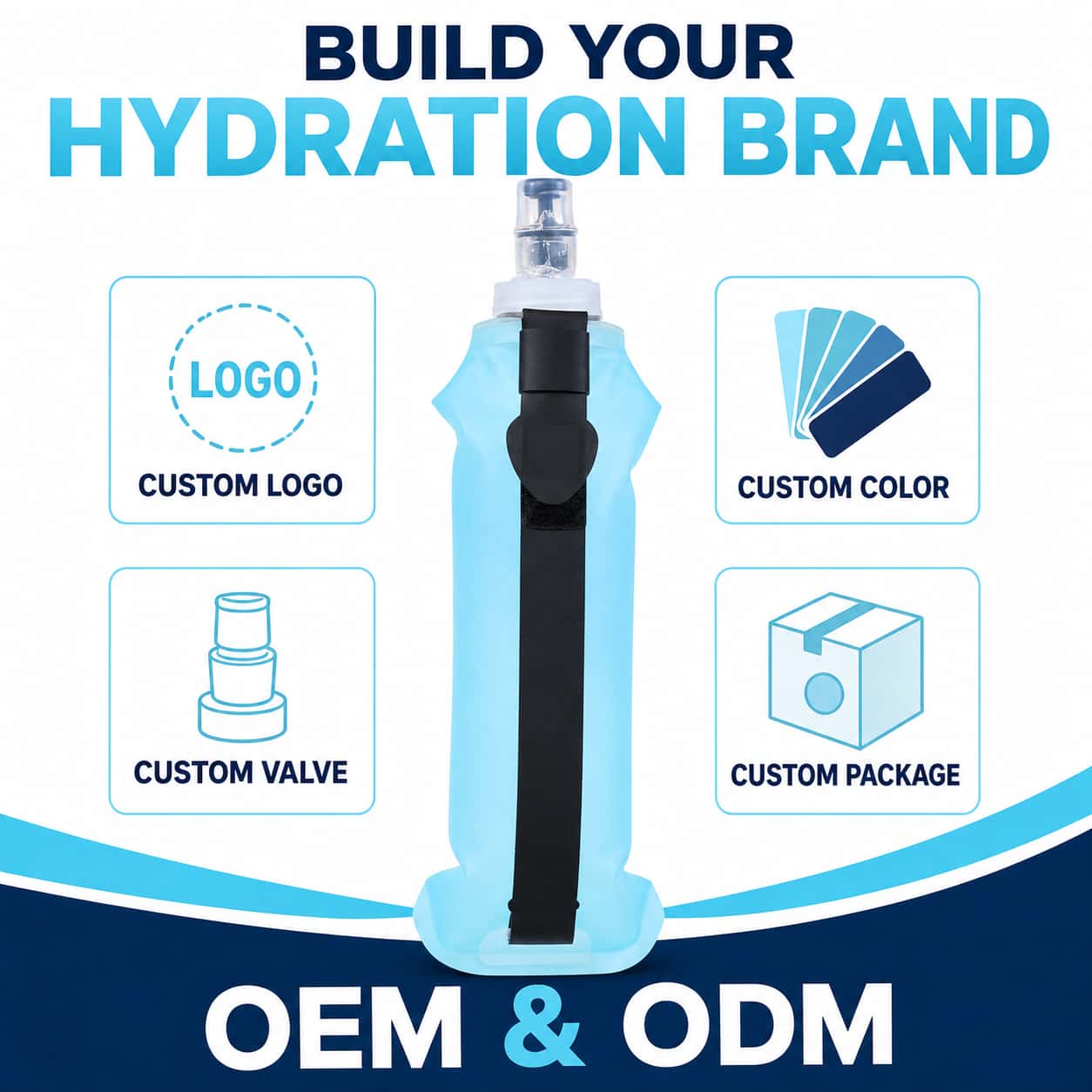
Honey Dry Bag provides OEM and ODM soft flask solutions for sports brands, distributors, events, and outdoor product companies. Contact us with the target capacity, shape, valve, straw, color, branding, packaging, use conditions, and destination market.