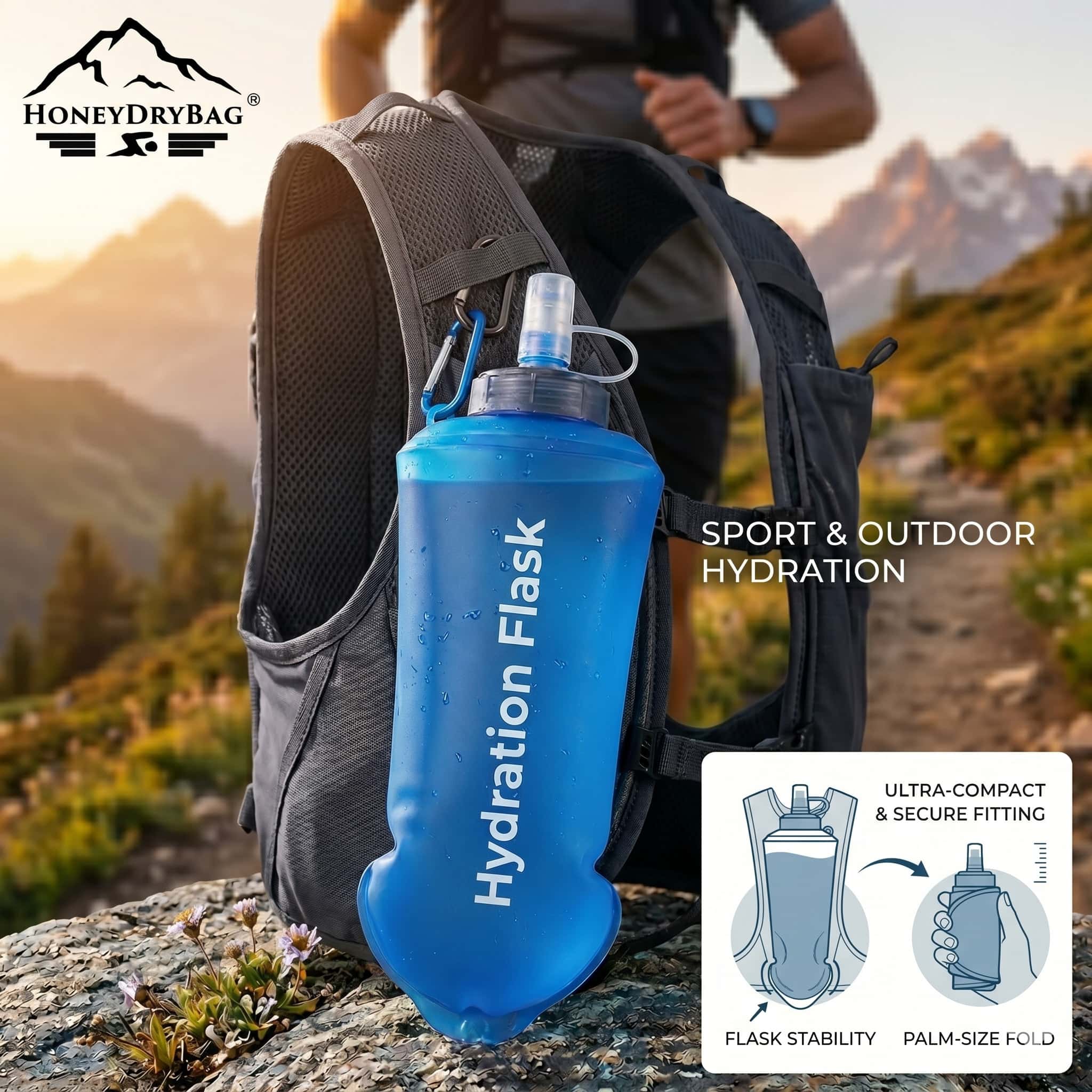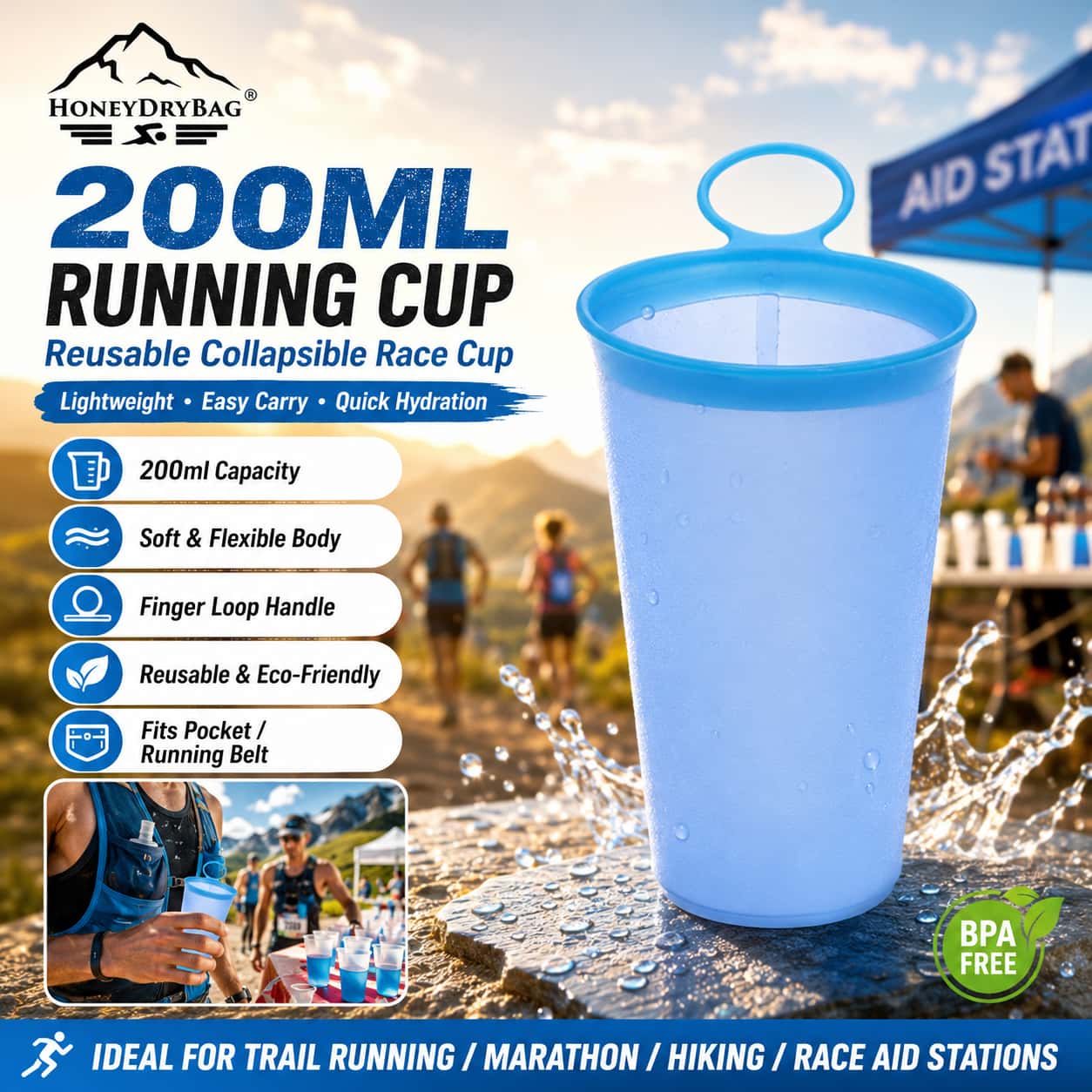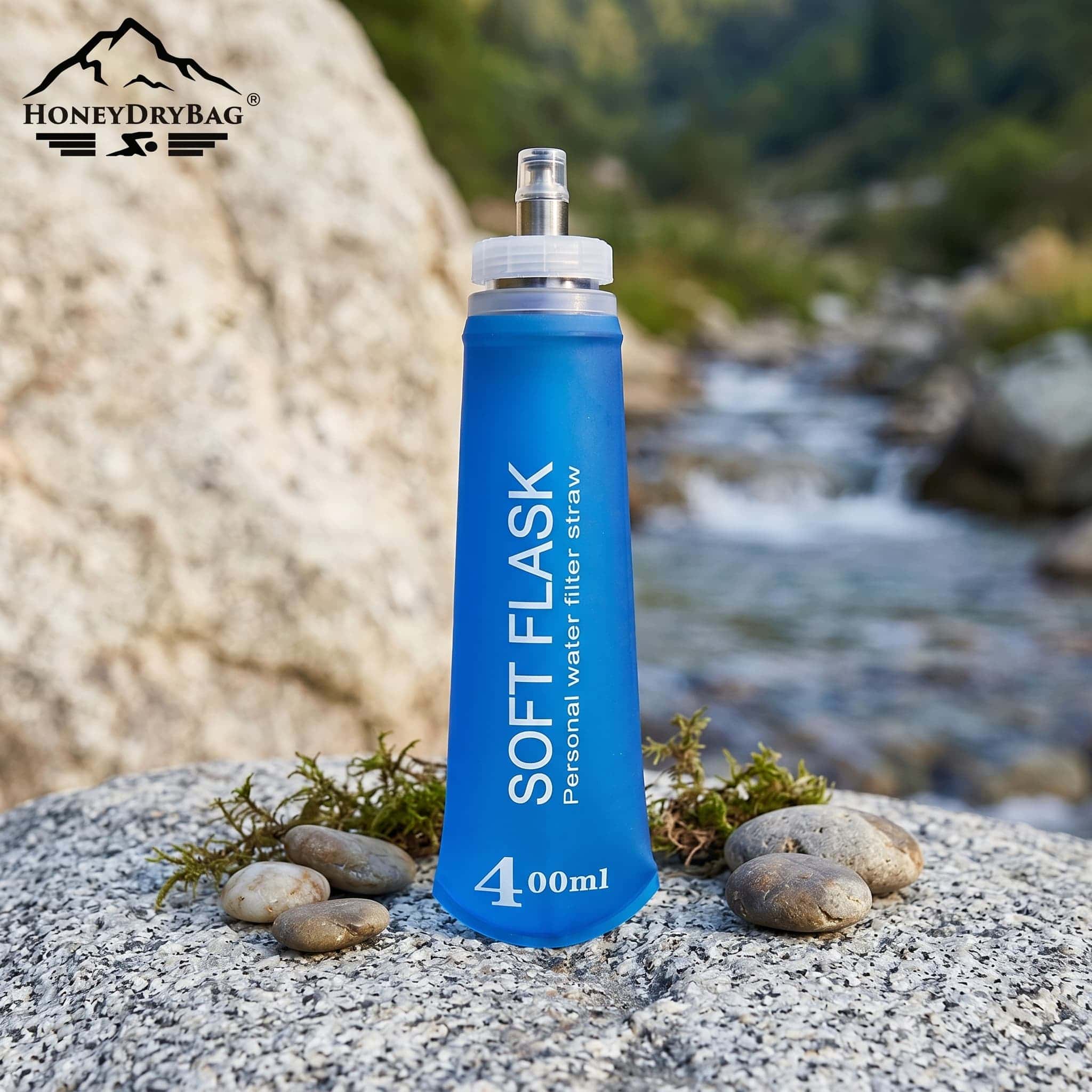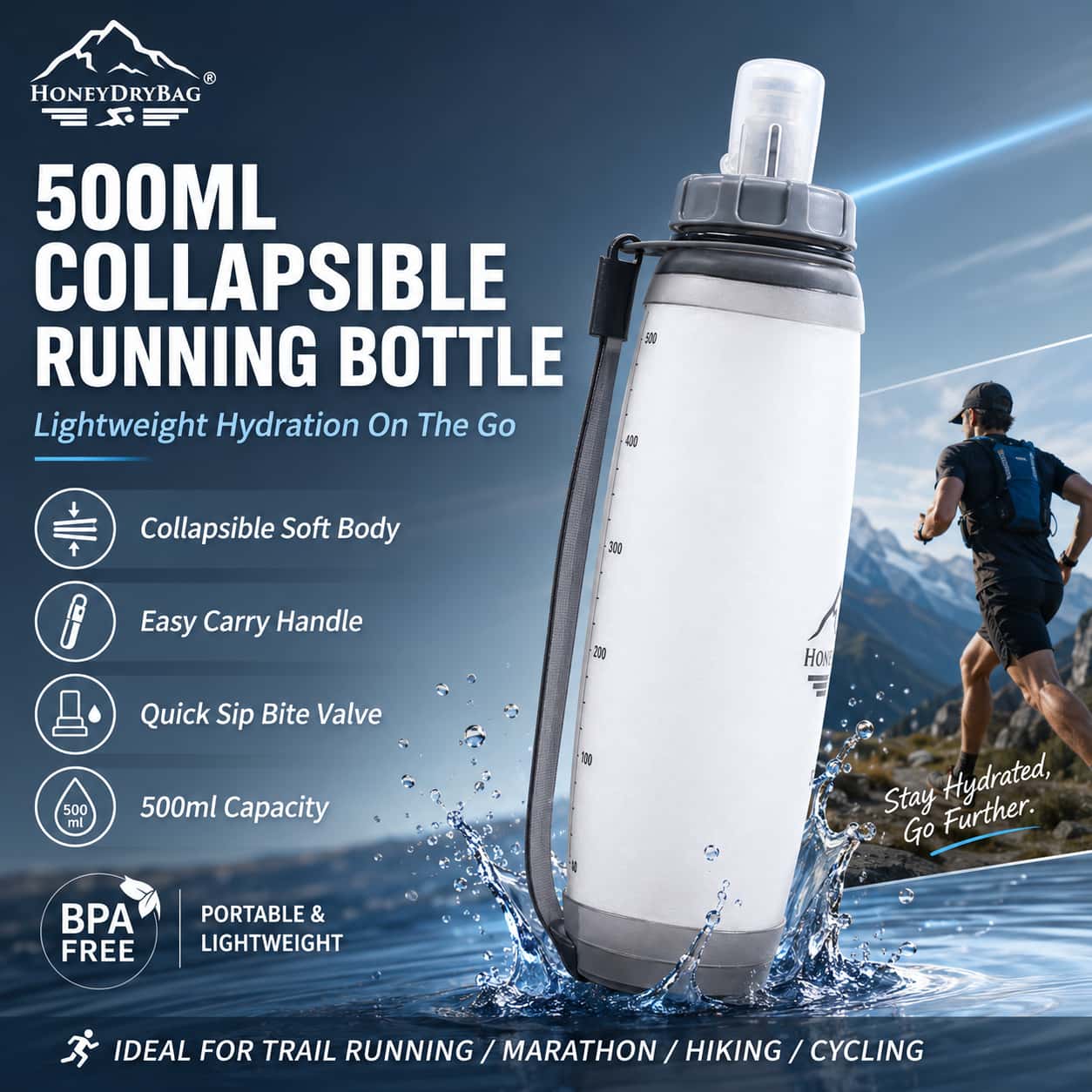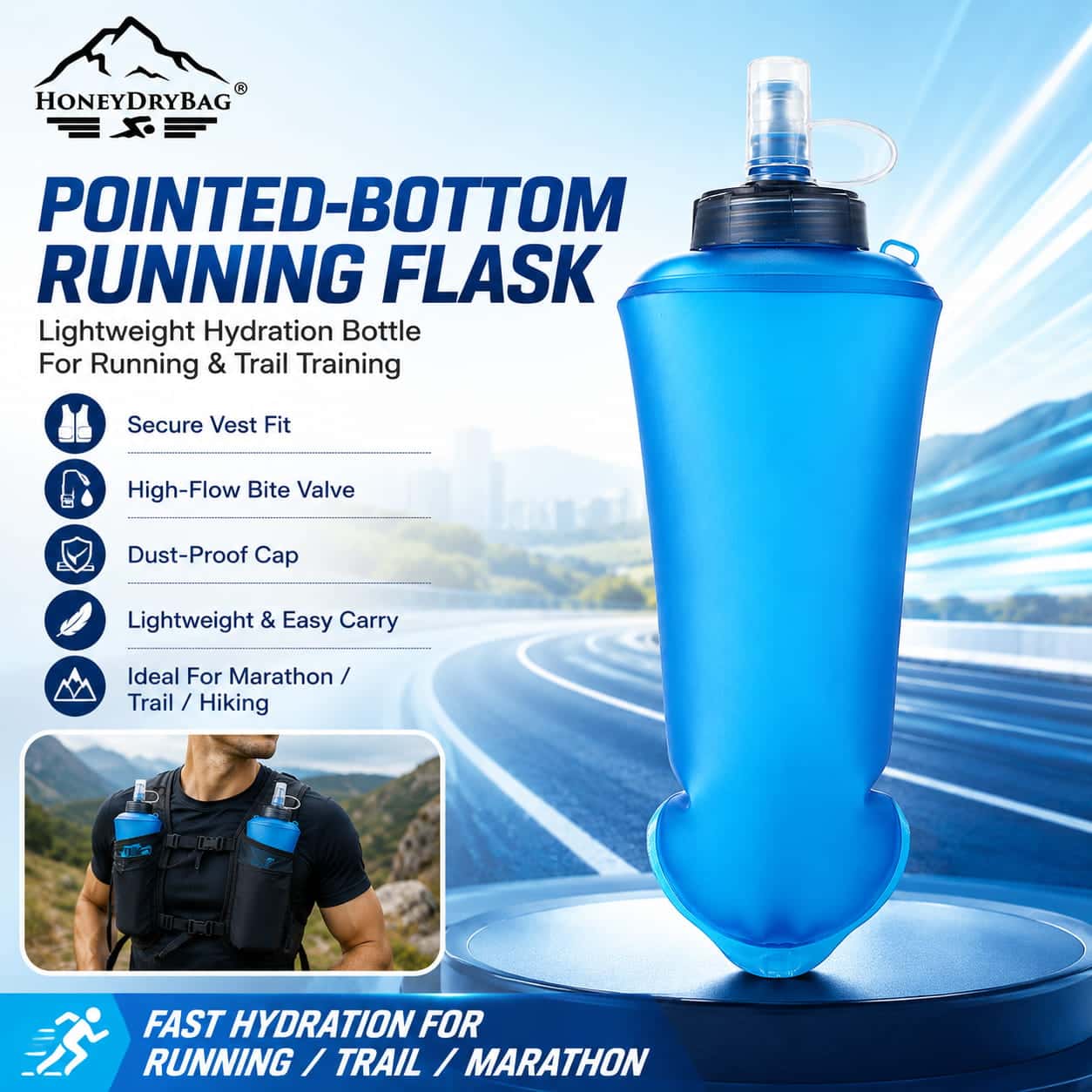
Quick answer: A soft flask is hard to refill at an aid station because its flexible body does not stay open or stand upright when empty. The runner must support the flask, open and manage the cap, aim the water or drink mix, leave enough headspace, confirm the seal, and return the filled flask to a vest—often with wet hands and limited time.
A wide-mouth soft flask can make pouring water, ice, or powder easier, but opening diameter is only one part of refill performance. Cap operation, neck support, closure feedback, flask shape, and vest compatibility affect the complete task.
Why Refilling a Soft Flask Is Different
A rigid bottle keeps its shape when it is empty. It can usually stand on a table or be held around the body while water is poured into it.
An empty soft flask behaves more like a flexible pouch:
- The body collapses and may twist.
- Opposing sidewalls can touch.
- The neck may tilt while the runner holds it.
- Squeezing the body can force liquid back toward the opening.
- The cap and valve may need to be handled separately.
- The filled flask still has to return to a close-fitting vest pocket.
These are not necessarily product defects. The same flexibility makes a soft flask light, comfortable, and compact after use. At a crowded race aid station, however, it can turn a simple pour into a sequence that requires both hands and more attention.
What Slows Down a Soft Flask Refill?
A Narrow Opening Requires More Aim
A small opening can work well for water from a controlled tap or bottle. It becomes less forgiving when the runner is using a large jug, adding drink powder, or trying to insert ice.
A wider opening creates a larger target and gives better access for cleaning. It also requires a larger neck and cap, which may add weight or affect how the flask sits beneath a vest retainer. Bigger is useful only when the complete design still fits the intended carrying system.
A Removable Cap Adds a Loose Part
With a conventional screw cap, the runner must hold the flask, remove the cap, keep it clean, align the threads, tighten it, and verify the seal.
That sequence is familiar and mechanically simple, but a loose cap can be dropped. Cross-threading is also easier when the runner is rushed or has wet, cold, or gloved hands.
A tethered or flip-open cap can remove the loose-part problem. The hinge, latch, gasket, and closing force then become additional design and durability considerations.
The Empty Body Offers Little Support
When a runner holds only the neck, the flask body may hang, fold, or swing. Water hitting a folded section can splash back or make the body collapse further.
A firmer neck-to-body transition can improve control. Too much reinforcement may add bulk or create a harder contact point in a running vest, so refill handling and body comfort should be tested together.
The Closure Gives Unclear Feedback
A cap that looks closed may not be fully sealed. Useful feedback can be an audible click, visible alignment, a defined locking position, or a consistent stop.
The feedback must remain reliable across production samples. Excessive closing force can make the cap hard to secure; insufficient force can make accidental opening more likely.
Some quick-fill systems are designed to open in one movement and provide audible or tactile feedback when closed. That performance must be verified on the specific finished cap rather than inferred from the opening diameter or mechanism name.
Overfilling Makes Closure Messy
Filling to the rim leaves little space for inserting or closing the cap. The neck may overflow when the runner grips the flask or tries to remove trapped air.
The usable fill level should be understandable. A reference line can help, but its meaning and accuracy need to be defined for the finished product.
Powder Reaches the Threads or Seal
Drink powder poured into a wet neck may collect on the threads, gasket, or sealing surface. Sticky sports drink can create a similar problem.
A larger opening can reduce spillage, but it cannot eliminate poor pouring technique or unsuitable cap geometry. The closure still needs to seal and remain cleanable under realistic race use.
Returning the Flask to the Vest Takes Time
A running flask refill is not complete when the cap closes. The runner must also remove excess air where appropriate, place the flask back in the pocket, and secure the retaining loop.
A large neck or cap may be easy to handle at the table but catch on the vest opening. Refill speed and running-vest compatibility should therefore be evaluated as one workflow.
28 mm vs. 42 mm Soft Flask Openings
The comparison below describes general design tendencies. Actual performance depends on the cap, neck, flask body, ice size, powder packaging, and filling equipment.
| Consideration | Smaller opening | Wider opening |
|---|---|---|
| Water filling | Functional but requires more aim | Provides a larger pouring target |
| Ice | Limited by the actual cube size | Usually accepts a wider range of ice sizes |
| Drink powder | Easier to spill around the neck | More room for a packet or scoop |
| Cap and neck | Usually smaller and lighter | Usually larger and potentially heavier |
| Cleaning access | More limited | Generally easier to access |
| Vest fit | Smaller neck profile | Must be checked against the pocket and retainer |
| Closure options | Commonly uses a simple screw cap | Allows more space for larger or quick-fill mechanisms |
A well-designed smaller opening can outperform a poorly designed wide-mouth system. Buyers should not treat 28 mm and 42 mm as complete performance grades unless the measurement method and finished cap design are also defined.
Screw Cap or Quick-Fill Cap?
A screw cap has fewer mechanisms, familiar threaded engagement, and straightforward replacement potential. Its main disadvantages are the required turns, the loose cap, and the possibility of cross-threading.
A quick-fill or flip-open cap can remain attached and reduce the number of movements during repeated refills. In exchange, the hinge and latch add parts that must survive repeated cycles, stay clean, and close with predictable force.
The better choice depends on the use case. A casual training flask may prioritize simplicity, while an ultramarathon product may place more value on fast operation with cold or wet hands. Neither claim should be approved from cap appearance alone.
How Can Runners Refill a Soft Flask Faster?
The most useful improvement is practice. Operate the actual flask before race day with the same drink mix and the same vest.
At the aid station:
- Remove the flask and hold it by the rigid neck or supported shoulder.
- Keep the drinking surface and cap away from the table or ground.
- Open the cap before pouring and keep any loose part under control.
- Add powder before or after water according to the product instructions and the packet design.
- Leave enough space to close the flask without forcing liquid over the seal.
- Confirm the expected click, alignment, or threaded stop.
- Check for leakage before returning the flask to the vest.
Pre-portioned drink mix can reduce packaging work where race rules allow it. Opening the flask before reaching the table may also save time when it can be done safely without obstructing other runners.
How Should B2B Buyers Test Refill Performance?
For brands developing a custom running soft flask, the test should measure the complete user task rather than the pouring step alone. Buyers who are still selecting material, capacity, valve, and basic construction can begin with our complete B2B guide to foldable TPU running water bottles before defining an aid-station protocol.
Define the Race Scenario
Record whether the intended user will refill with:
- Plain water
- Premixed sports drink
- Powdered drink mix
- Ice
- A race jug, dispenser, bottle, or volunteer-assisted system
Energy gel or another viscous product should be included only when the flask and closure are intended and validated for that use.
Time the Complete Sequence
The measured workflow should include:
- Removing the flask from the target vest
- Opening the cap
- Filling to the intended level
- Adding the intended supplement, if applicable
- Closing and confirming the seal
- Removing excess air where appropriate
- Returning the flask to the vest
- Securing the retainer
- Checking for leakage
Record failed attempts and handling errors as well as elapsed time. A fast average can hide a cap that occasionally cross-threads, fails to latch, or spills.
Change the Handling Conditions
Include users with different hand sizes and levels of familiarity. Repeat the sequence with wet hands and, where relevant, cold or gloved hands.
Test the cap after repeated opening and closing. Closing force, thread engagement, hinge behavior, gasket position, and leakage should remain within the approved criteria.
Introduce Realistic Residue
If powder or sports drink may contact the neck during use, define a repeatable contamination condition and check whether the cap still closes, seals, and cleans correctly.
Do not use uncontrolled residue tests as a substitute for a written method. The amount, liquid, cleaning step, and acceptance criteria should be recorded.
Check Vest Reinsertion
Test the filled flask in the intended vest with adjacent pockets loaded. Confirm that the cap passes the pocket opening, the flask reaches the intended position, and the bite valve remains accessible.
B2B Aid-Station Refill Checklist
Before approving a sample, confirm:
- The opening suits the intended liquid, powder packet, and ice size.
- The empty flask can be controlled without squeezing the middle.
- The cap can be opened and closed with wet hands.
- Loose components are not easily dropped.
- Closure feedback is clear and repeatable.
- Threads or latches remain functional after realistic residue exposure.
- The closed flask passes an immediate invert-and-squeeze leak check.
- The filled flask returns to the target vest.
- Repeated opening does not produce unacceptable hinge, seal, or thread changes.
- Production samples match the approved dimensions and closing-force criteria.
- Cleaning instructions cover the cap, valve, gasket, and permitted removable parts.
Questions to Ask a Soft Flask Manufacturer
- Which opening dimensions and cap systems are available for sampling?
- How is opening diameter measured?
- Can the cap remain attached during filling?
- What indicates complete closure?
- How are closing force and leakage evaluated?
- What repeated-opening test method is available?
- Which liquids, powders, or ice sizes were included in product testing?
- Can the flask be evaluated in the buyer's target running vest?
- Are replacement caps, valves, or gaskets available?
- Which cap components are designed to be removed for cleaning?
- Can production samples be checked against the approved refill workflow?
These questions identify what must be confirmed with the supplier. They do not assume that every option or test is currently available for every Honey Dry Bag model.
Final Takeaway
Soft flask refill difficulty comes from the entire aid-station sequence, not flexibility alone. Opening diameter, cap design, neck support, closure feedback, residue, headspace, and vest fit all influence whether the runner can refill quickly and leave with a properly sealed flask.
Runners should practise with their actual drink and carrying system before race day. B2B buyers should define a realistic workflow, record errors as well as time, and approve the complete flask-and-vest combination rather than relying on a wide-mouth label.
Honey Dry Bag works with running and outdoor brands on OEM and ODM soft flask projects. Contact us with the intended race scenario, target capacity, opening and cap requirements, valve, flask dimensions, branding, packaging, and target vest so the available development options can be evaluated.